
Home » Resources » AI Security Glossary » Data Exfiltration
Data Exfiltration In AI Security
- Last Updated: June 8, 2026
Data exfiltration in AI security is the unauthorized extraction of sensitive information through AI systems. Attackers use prompt manipulation, model memorization, or unmonitored AI tool usage. These methods pull confidential data out of an organization. The data leaves through natural language, not file transfers or network packets

Comprehensive AI Security Policies
Start applying our free customizable policy templates today and secure AI with confidence.
Why It Matters
Cyberhaven’s 2025 AI Adoption and Risk Report analyzed actual AI usage patterns across 7 million workers and found that 34.8% of corporate data employees input into AI tools is classified as sensitive, more than triple the 10.7% observed two years prior.
The most common categories are source code (18.7%), R&D materials (17.1%), and sales and marketing data (10.7%).
The 2026 Unit 42 Global Incident Response Report tracks exfiltration speed across real incidents. In a simulated AI-assisted attack, Unit 42 was able to reach steal data in 25 minutes.
- OWASP LLM Top 10 2025 elevated Sensitive Information Disclosure to LLM02. The entry covers PII disclosure during model interactions, proprietary algorithm exposure through model outputs, and confidential data leakage from training data inclusion. No single control addresses all three pathways because each exploits a different layer of the AI stack.
- NIST AI 100-2 E2025 classifies model memorization and membership inference as privacy attack techniques within its adversarial ML taxonomy. The March 2025 edition expanded the framework to address generative AI-specific privacy attacks that the 2023 version did not cover.
- GDPR Article 33 requires 72-hour breach notification when personal data is exposed through any system, including AI.
- EU AI Act Article 16 adds provider obligations for high-risk AI systems to prevent reasonably foreseeable data exposure. Violations trigger GDPR penalties up to EUR 20 million or 4% of global annual turnover, with additional AI Act penalties up to EUR 15 million or 3% for non-compliance with provider obligations.
Who Is At Risk?
AI systems integrators and employees carry the highest exposure to this risk.
Integrators move data between AI systems, databases, and external services automatically, creating bidirectional exfiltration channels with no human inspection point between them.
Employees paste source code, customer data, and internal documents into AI interfaces daily, with 47% accessing tools through personal accounts that bypass every enterprise security control.
AI builders carry direct responsibility for training data that persists in model weights and becomes extractable through memorization attacks. AI DevOps teams own the runtime layer where multi-turn exfiltration executes through API channels they deploy and monitor.
Datacenter and network operators face regulatory-boundary exposure when AI workloads route data to external cloud services, violating GDPR, HIPAA, or data residency requirements.
How PurpleSec Classifies AI Data Exfiltration Risks
The PromptShield™ Risk Management Framework classifies data exfiltration as R3, within the data breach and privacy violation risk category. R3 carries a Critical risk rating.
The combination of critical impact and high likelihood reflects a threat that is actively occurring across enterprises and exploits the same channel organizations depend on for AI-driven productivity.
Field | Detail |
Root Cause | LLMs trust malicious embedded prompts in data/files. |
Consequences | Data breach (PII, credentials, IP), GDPR violations. |
Impact | Critical |
Likelihood | High |
Detectability | Medium |
Risk Rating | Critical |
Residual Risk | Medium |
Mitigation | DLP scanning, redaction, input sanitization, monitoring outputs for sensitive patterns. |
Owner | Compliance Officer |
Review Frequency | Quarterly |
"When we scored data exfiltration, the debate was whether Likelihood belonged at Medium or High. We ran it against real enterprise telemetry. Every organization with unmanaged AI tool access showed sensitive data leaving through prompts within the first week. That moved Likelihood to High. The Critical rating followed because you cannot reduce Impact without removing AI access entirely, and Detectability is Medium because the evidence exists in prompt and response logs. Most organizations are not logging yet."
Tom vazdar, caio, purplesec
PurpleSec’s AI Readiness Framework places data exfiltration under D1 Section 3.2 (Security & Privacy) and D1 Section 3.1 (Adversarial Robustness).
Two subsections address this risk directly:
- Section 3.2.1 (Data Classification and Handling) requires organizations to classify AI and training data based on sensitivity, value, regulatory implications, and risk exposure, with documented workflows for secure storage, transfer, retention, review, and disposal at each classification level. Standards-based encryption, anonymization, pseudonymization, masking, and access controls tie directly to classification outcomes.
- Section 3.1.3 (Model Security Operations and Lifecycle Protection) addresses the adversarial extraction surface, covering inversion attacks designed to compromise model confidentiality, uncover sensitive training data, or reconstruct restricted model details, alongside extraction attacks aimed at reverse-engineering proprietary model logic. Controls include restricted APIs, query monitoring, adversarial detection software, and removal of sensitive model artifacts from production environments.
R3 maps across both sub-domains because exfiltration exploits two distinct control boundaries. Data Classification governs what sensitive data enters AI systems and how it is protected at rest and in transit.
Lifecycle Protection governs what data can be extracted from deployed models through adversarial techniques after it has already entered the system.
Organizations that implement only one leave the other exposed.
Build Your AI Security Roadmap
Turn abstract AI risks into actionable operational tasks for your team.

The following AI security policy templates address these controls directly:
- AI Data Governance Policy: Section 2.1 defines AI-specific exfiltration risks including model memorization and inference attacks. The Enhanced Classification Matrix (Levels 0–3) restricts what data AI systems can access, with mandatory PII sanitization and Data-BOM provenance tracking for all data entering model pipelines.
- AI Acceptable Use Policy: Section 3.2 classifies data exfiltration via AI as a critical violation. The three-tier tool classification framework explicitly prohibits inputting credentials, source code, or customer PII into Tier 3 (Prohibited) AI services, with DLP monitoring mandated across all tiers.
- AI Gateway Implementation Checklist: Phase 3 (Output Guardrails) deploys Data Leakage Prevention at Layer 2 with input/output PII scanning, credential detection, and system prompt leakage prevention. Target KPI: zero PII leakage incidents per month.
- AI Incident Response Playbook: IC-3 (Data Exfiltration) provides a complete containment and eradication procedure for AI data leaks, including credential revocation, RAG access blocking, output DLP tightening, and GDPR 72-hour notification requirements. Includes a detailed P1 walkthrough scenario of a prompt injection data exfiltration incident.
- AI Red Teaming Checklist: The Information Disclosure testing section mandates specific attack procedures for PII extraction, credential leakage, training data memorization via leakreplay, and multi-tool exfiltration chains to proactively identify exfiltration vulnerabilities before attackers do.
How It Works
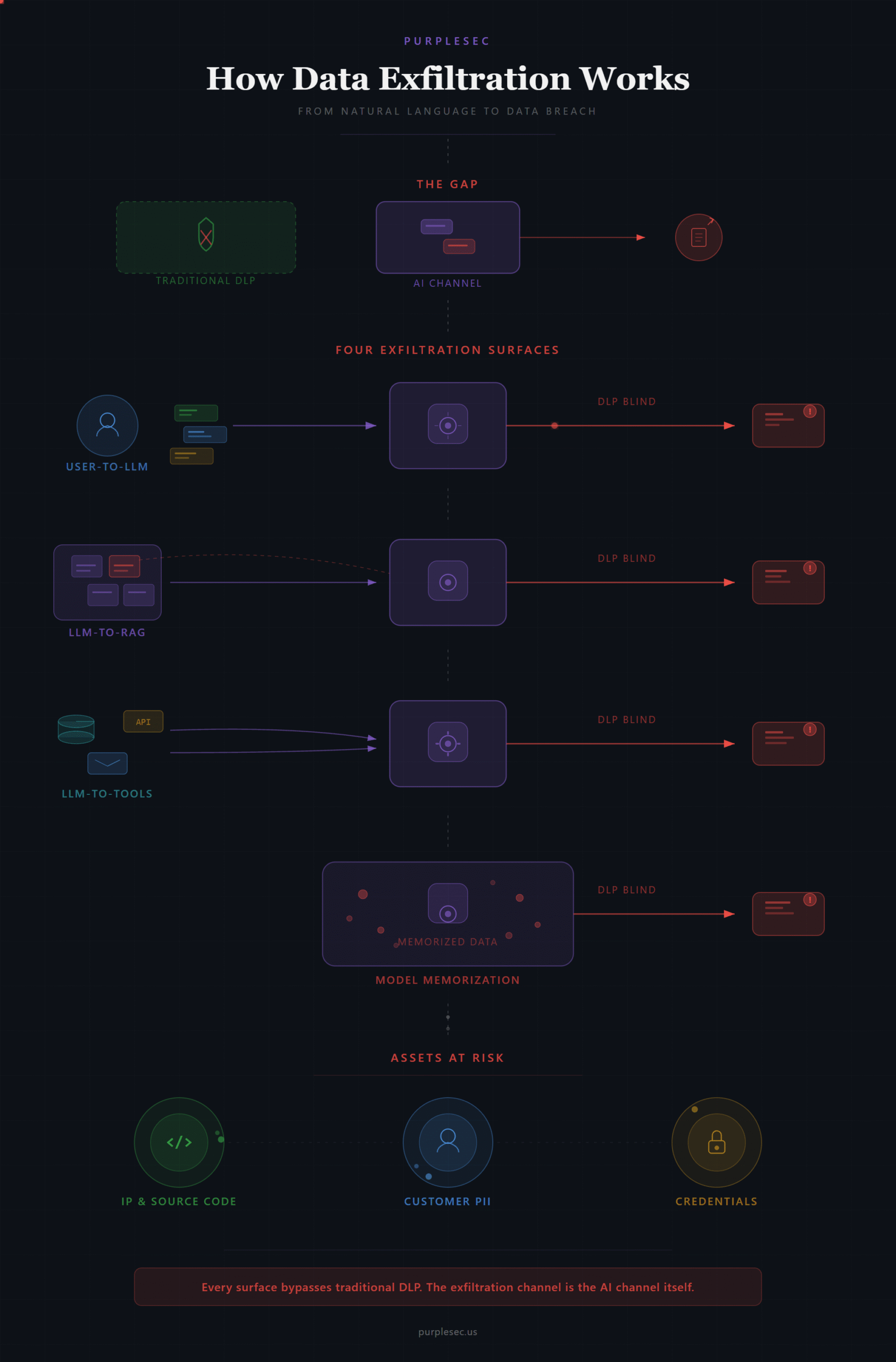
Data exfiltration through AI systems exploits a fundamental gap: Sensitive data moves through natural language channels that traditional security controls were never designed to inspect. Each exfiltration pathway targets a different trust boundary between users, models, and connected data sources.
Surface | How Data Leaves | Why DLP Misses It |
User-To-LLM | Employees paste sensitive data, upload documents, or feed information through automated integrations (Slack, CRM, email) into AI prompts and API calls. | Input travels as natural language or document content, not a file transfer or database query. Shadow AI on personal accounts bypasses corporate DLP entirely. |
LLM-To-RAG | Poisoned documents in the retrieval corpus contain embedded adversarial instructions. A legitimate user query retrieves the poisoned document, and the model executes the hidden instructions to surface or transmit sensitive data from other retrieved content. | The retrieval system followed its instructions. The instructions were adversarial. The retrieval path and API calls are identical to legitimate operations. |
LLM-To-Tools | AI agents with tool access execute API calls and database queries directed by compromised prompts, poisoned tool outputs, or chained tool abuse where the agent reads from one system and writes to another. | Agent actions execute as authorized API calls within permitted access scopes. Each individual operation is legitimate. The exfiltration occurs through the composition of authorized actions. |
Model Memorization | The model reproduces PII, credentials, or code fragments from training data without any user submission. | No sensitive input exists in the current session. The data originates from the model’s parameters. Even output-side DLP struggles because memorized data is interleaved with generated text. |
These attack surfaces threaten three distinct asset categories:
- Intellectual Property And Source Code: The most frequently exposed data category. Proprietary code, R&D materials, and trade secrets enter AI systems through developer workflows, code review tools, and automated CI/CD integrations.
- Customer PII And Regulated Data: Personal data, health records, and financial information trigger regulatory notification obligations when exposed through AI channels. The compliance cost compounds because AI-mediated exposure often lacks the forensic trail traditional breaches produce.
- Credentials And Infrastructure Secrets: API keys, authentication tokens, and internal system configurations exposed through AI prompts or model memorization grant attackers direct access to production infrastructure beyond the AI system itself.
AI Data Exfiltration Attacks & Techniques
Five primary techniques drive AI data exfiltration. Each exploits a different trust boundary between users, models, and the data they access:
- Prompt Injection For Forced Disclosure: An attacker embeds instructions that override the system prompt, directing the model to output sensitive context or retrieved documents. Direct injection targets the input field. Indirect injection hides instructions in documents, emails, or web pages the model processes.
- Model Memorization Extraction: An attacker queries a model with contextually similar prompts to trigger reproduction of training data. Nasr et al. (2023) demonstrated that adversaries can extract gigabytes from production models. The sensitive data originates from model weights, not from the user’s prompt.
- Shadow AI Data Leakage: Employees paste contracts, financial projections, and proprietary code into consumer chatbots. The AI service may use this data for model training. No attacker is involved. The threat is structural, not adversarial.
- Indirect Injection via External Content: An attacker plants adversarial instructions in web pages or documents that AI agents retrieve during tool use. Rall et al. (2025) demonstrated this against agents with web search access. The malicious payload reaches the model through its own retrieval actions.
- Agentic Tool Abuse: An attacker redirects an AI agent’s tool access to retrieve sensitive data using the agent’s legitimate credentials. Trend Micro (2025) documented hidden instructions in images and documents that trigger exfiltration without user interaction. The agent’s actions appear authorized. The intent behind them is not.
Samsung's ChatGPT Data Leak: Real-World Impact Of AI Data Exfiltration
In March 2023, Samsung Semiconductor approved ChatGPT for employee use. Within three weeks, Samsung engineers leaked confidential data in at least three separate incidents, each through routine productivity tasks.
- In the first incident, an engineer pasted faulty source code from a semiconductor measurement database into ChatGPT to find a fix.
- The second incident involved an employee submitting proprietary program code for defective equipment identification, requesting code optimization.
- In the third, an employee fed internal meeting content into ChatGPT to generate meeting minutes.
No attacker was involved in any case. No exploit was deployed. Each employee used the tool for its intended purpose. The exfiltration occurred because every prompt submitted to ChatGPT became training data on OpenAI’s servers.
Samsung confirmed the data was impossible to retrieve.

Samsung’s response was immediate but reactive:
The company developed an in-house AI tool with prompts limited to 1,024 bytes and restricted ChatGPT usage across the semiconductor division.
The Samsung incident exposed the structural gap that makes AI data exfiltration different from every previous data loss vector. Traditional DLP monitors file transfers, email attachments, and USB devices. None of those controls inspect what an employee types into a chat interface.
The exfiltration channel is the productivity tool itself.
Detection And Defense
Stopping AI data exfiltration requires three controls operating across input, output, and behavioral layers simultaneously:
- Input Classification And Redaction: Scanning prompts and uploaded documents for sensitive data patterns before they reach the model reduces voluntary exfiltration through shadow AI and authorized AI tool usage. Pattern-based detection catches structured data like credentials and PII. Context-dependent data requires AI-powered classification to identify sensitivity from surrounding content.
- Output DLP Inspection: Monitoring model responses for PII, credentials, source code patterns, and data signatures catches structured exfiltration from prompt injection-forced disclosure. Memorized data interleaved with generated text remains harder to detect, which is why output DLP works best as one layer in a defense-in-depth approach rather than a standalone control.
- Behavioral Baseline Monitoring: Tracking interaction patterns, data access frequencies, and response content categories surfaces systematic exfiltration that per-request filtering misses.

How Intent-Based Detection Address AI Data Exfiltration
Intent-based detection analyzes the purpose behind each interaction rather than matching data patterns in isolation. This catches indirect prompt injection because the detection logic evaluates what the AI is being asked to do with the data, not just whether sensitive terms appear.
A legitimate CRM query and a prompt injection-forced data extraction may access the same records, but their behavioral intent signatures diverge.
PromptShield™ implements intent-based detection as the primary runtime control for AI data exfiltration:
In-Model Extraction: Traditional DLP monitors network channels, not the reasoning process inside a model where extraction actually occurs. PromptShield™ inspects prompt and response activity in real time across browser extension, API gateway, and inline blocking deployments — evaluating both inbound exposure risk and outbound leakage patterns.
Obfuscated Exfiltration: Attackers encode sensitive data across multiple turns, embed extraction logic in retrieval documents, or use prompt obfuscation to disguise requests. The detection engine combines pattern libraries with LLM-based semantic analysis informed by PurpleSec’s 21-category AI threat taxonomy, substantially reducing manual rule maintenance as new techniques emerge.
RAG And Agentic Exfiltration: Poisoned documents or chained tool calls can extract data without any malicious user input. PromptShield™ inspects retrieved content and tool-calling chains before they enter the model’s context window, catching these vectors at the interaction layer rather than at the perimeter.
"The gap we kept finding in enterprise deployments was that organizations had DLP for email, DLP for endpoints, and DLP for cloud storage, but zero DLP for the AI channel. PromptShield™ closes that gap by inspecting what goes into and comes out of every AI interaction."
joshua selvidge, CTO, PurpleSec
When tuning PromptShield™’s detection engine for data exfiltration, the highest-value target was indirect prompt injection. Unlike shadow AI exposure, which can be addressed through access policy, injection-driven exfiltration is adversarial and adaptive.
The most reliable detection approach was training the classifier to evaluate data flow intent:
Is this interaction trying to move sensitive data outside its authorized boundary?
When the answer is yes, whether the mechanism is an employee paste, an injected instruction, or a memorization trigger, the classification fires regardless of the exfiltration technique.
Secure Every AI Interaction With PromptShield™
Understand the why behind every prompt, response, and agent action in real time, so you can confidently audit, question, and govern AI.
Contents

Free AI Readiness Assessment
Implement AI faster with confidence. Identify critical gaps in your AI strategy and align your security operations with your deployment goals.
Frequently Asked Questions
How Does Data Exfiltration Through AI Differ From Traditional Data Breaches In Terms Of Incident Response?
AI-mediated data exfiltration requires a parallel incident response track. Traditional breaches have identifiable entry points: a compromised credential, a vulnerability exploit, a malicious file. AI exfiltration often has no exploit signature because the data left through an authorized interaction channel. The AI Incident Response Playbook defines IC-3 (Data Exfiltration) with specific containment procedures: isolate the AI gateway, preserve prompt and response logs as forensic evidence, and initiate GDPR 72-hour notification if personal data exposure is confirmed. Standard IR playbooks lack these AI-specific steps.
Can An AI Model Leak Sensitive Data Even If No One Submits It In A Prompt?
Yes. Model memorization means LLMs can reproduce PII, API keys, source code, and other sensitive data that appeared in their training sets. The data exists in the model’s parameters, not in any current session input. This is why output-side DLP is essential. Input scanning cannot catch data that originates from within the model itself. Organizations deploying third-party models should evaluate whether the provider documents memorization testing in their model card.
What Is The Biggest Data Exfiltration Risk For Organizations That Have Already Deployed AI Tools?
Shadow AI. These interactions are invisible to IT. The data exposure is not from sophisticated attacks but from employees pasting customer records, internal documents, and source code into consumer AI interfaces as part of daily work. An AI Acceptable Use Policy with enforced tool-tier classifications is the first control to deploy.
How Do RAG Systems Create New Data Exfiltration Pathways?
Retrieval-Augmented Generation connects models to document stores, databases, and knowledge bases. This expands the model’s access scope far beyond its training data. A prompt injection that manipulates the retrieval query can surface documents the user is not authorized to access and include them in the model’s response. The exfiltration occurs through the model’s legitimate retrieval mechanism. AI gateway controls must inspect both the retrieval query and the retrieved content before the model generates its response.
What Compliance Obligations Does AI-Mediated Data Exfiltration Trigger?
Under GDPR, any unauthorized exposure of personal data through an AI system triggers the same 72-hour notification obligation as a traditional breach. The EU AI Act adds provider accountability for reasonably foreseeable data exposure, meaning the organization cannot claim the exfiltration was unintended if the AI system had access to personal data without adequate safeguards. HIPAA-covered entities face additional obligations when protected health information is exposed through AI tools. Compliance teams should map every AI system’s data access scope against their regulatory notification obligations before deployment.
How Should DevOps Teams Secure AI Model APIs Against Credential-Based Exfiltration?
Stolen or leaked API credentials give attackers direct access to enterprise AI models and any data those models can access. Rotate credentials on short cycles, enforce least-privilege access scoping per API key, and monitor for anomalous usage patterns such as unusual query volumes, off-hours access, or requests for data categories that diverge from the key’s intended use case.
Related Terms
Injection is the primary technique for extracting data. Attackers embed exfiltration instructions in prompts or external content the model processes.
Both target the same goal (extracting sensitive information) but through different mechanisms: input manipulation vs. output analysis.
Hidden instructions in documents can direct a model to leak data without the user or operator being aware of the exfiltration channel.
Insiders with legitimate access can use the AI system as a data exfiltration tool, querying for sensitive information under the cover of normal use.