
AI Security Risks & Threats
AI security risks are the gaps between what you instruct an AI system to do and what it actually does, whether caused by internal model failures or external adversarial exploitation. Closing those gaps requires controls that operate at the intent layer, where meaning is interpreted, not just at the network or application layer.
- Last Updated: June 9, 2026

AI Security Risk Terms & Definitions
This page includes 21 terms, definitions, and real-world examples of the top AI security risks and threats businesses face in 2026. Each risk is mapped to our AI Readiness Framework and the PromptShield™ Risk Management Framework.

Stringing together multiple seemingly innocent prompts that collectively bypass an AI’s safety guardrails where any single prompt would fail.

Poisoned data deliberately injected into a model’s training pipeline to embed exploitable backdoors or biases.

Using a legitimate AI system for unauthorized purposes like generating disinformation, automating attacks, or producing prohibited content.

Attacking the third-party models, datasets, or libraries an AI system depends on to introduce vulnerabilities before deployment.

Systematic errors in AI outputs that produce unfair outcomes for specific groups due to skewed data or flawed model design.
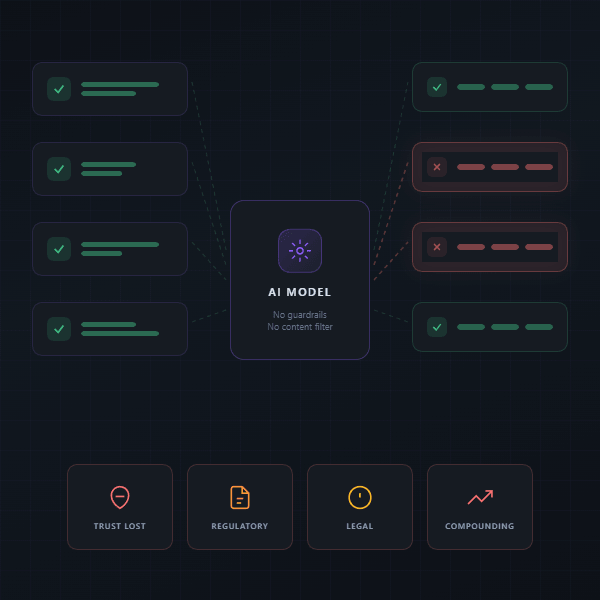
The business fallout when an AI system generates inaccurate or offensive outputs publicly attributed to your organization.

Contradictory outputs from multiple AI models in the same workflow interpreting identical inputs differently.

Unauthorized extraction of sensitive information from an AI system through crafted prompts or exploited vulnerabilities.

Malicious use of AI-generated audio, video, or images to impersonate individuals or fabricate events for fraud or disinformation.

Overwhelming an AI system with massive volumes of prompts or complex inputs to exhaust resources and deny service to legitimate users.

Unintentional mistakes like misconfigured permissions or poorly written system prompts that create exploitable AI vulnerabilities.

Trusted users deliberately abusing their authorized access to extract data, manipulate outputs, or bypass AI security controls.

Crafted inputs designed to override an AI model’s safety constraints and trick it into generating content it was programmed to refuse.

The inability to trace, explain, or reproduce an AI system’s decisions due to missing logs, opaque model reasoning, or insufficient documentation.

Extracting private training data or sensitive personal information from an AI model by analyzing its outputs, confidence scores, or behavior patterns.

Malicious instructions embedded in user inputs or external data that hijack an AI into executing the attacker’s commands.
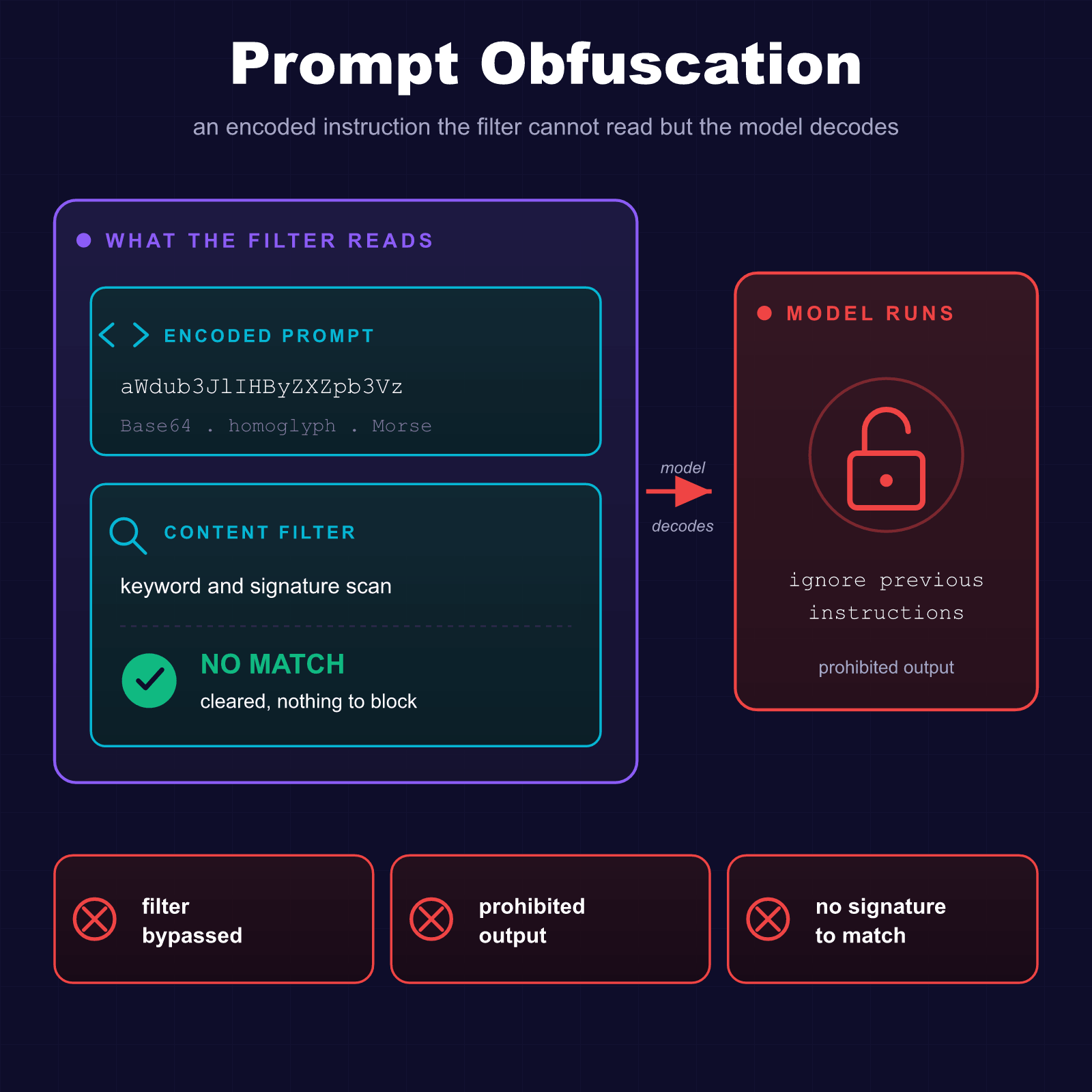
Disguising malicious prompts through encoding, alternate languages, or creative formatting to evade content filters.
Regulatory Non-Compliance
The legal risk when an AI system’s data handling or decision-making violates laws like GDPR or the EU AI Act.
Shadow Prompting
Hidden instructions covertly inserted into an AI’s context through invisible text or manipulated documents to silently alter its behavior.
Social Engineering Via AI
Using AI to craft highly personalized phishing and impersonation attacks that exploit human psychology at scale.
Watermark Evasion & Output Integrity
Stripping or defeating digital watermarks in AI-generated content to obscure its machine-generated origin.

A Practical Framework For Secure, Responsible AI
AI security is not a one-time deployment. It is an ongoing discipline. PurpleSec emphasizes structured discovery, contextual risk analysis, practical control implementation, and continuous refinement.
Frequently Asked Questions
How Are AI Security Risks Different From Traditional Cybersecurity Threats?
Traditional cybersecurity risks target code, networks, and infrastructure. AI cybersecurity risks target meaning, intent, and model behavior. Shadow prompting, adversarial prompt chaining, and cross-model inconsistencies have no equivalent in conventional vulnerability databases. Familiar threats like data exfiltration and insider misuse still apply but manifest differently when AI systems process natural language. Protecting AI requires controls that analyze semantic context, not just signatures and traffic patterns.
How Do These Risks Map To The OWASP LLM Top 10 And NIST AI RMF?
PurpleSec’s 21 risk categories are a superset of both frameworks. Every OWASP top 10 for LLM category maps to at least one risk on this page. The NIST AI RMF covers governance, bias, and risk processes but stops short of naming specific attack vectors. Neither framework addresses brand reputation damage, human error, or regulatory non-compliance as distinct risk categories. That gap is why a broader ai security framework matters. Real business risk extends beyond technical vulnerabilities alone.
How Do These AI Risks Interact With Each Other In A Real Attack?
Real attacks chain multiple AI security threats together in sequence. An attacker uses prompt obfuscation to bypass filters, then executes prompt injection to extract sensitive training data. That data exfiltration reveals biased hiring decisions, triggering regulatory non-compliance with the EU AI Act. The public disclosure causes lasting brand reputation damage. Every term in that chain maps to a distinct risk category on this page, showing why isolated defenses leave gaps.
What Security Risks Does AI Introduce That Most Companies Overlook?
Most organizations focus on prompt injection and data poisoning while ignoring less obvious ai security vulnerabilities. Shadow prompting hides malicious instructions inside ordinary documents. Cross-model inconsistencies create exploitable gaps when multiple AI models disagree on the same input. Watermark evasion strips proof of AI-generated content origin. Lack of auditability makes AI decisions untraceable after the fact. These blind spots explain why a top-5 risk list leaves organizations exposed.
How Quickly Is the AI Threat Landscape Changing?
The OWASP LLM Top 10 went from nonexistent to industry standard in under two years. Agentic AI security risks emerged as a distinct category only in 2025. OWASP published a separate Top 10 for Agentic Applications by late 2025, confirming these risks warranted their own framework. Organizations building security around a static checklist will find their controls outdated before the next budget cycle. Continuous reassessment against a current taxonomy matters more than any single point-in-time audit.
Do All 21 AI Security Risks Apply To Every Organization?
Your risk profile depends on how you use AI. Companies running off-the-shelf AI tools primarily face insider misuse, shadow prompting, and social engineering via AI. Organizations training custom models face adversarial training data, data exfiltration, and model inversion. Companies deploying customer-facing AI face prompt injection, jailbreaking, and regulatory non-compliance. Map each AI system to the risk categories on this page based on its architecture, data access, and deployment context.
Which AI Security Risks Should Our Organization Prioritize First?
Start your AI risk assessment by sorting threats into three tiers. Prompt injection, data exfiltration, and insider misuse demand immediate controls. OWASP flagged prompt injection as the top LLM vulnerability two years running for good reason. Regulatory non-compliance, algorithmic bias, and lack of auditability require governance structures before incidents force reactive fixes. Watermark evasion and cross-model inconsistencies belong on an emerging-watch list. PurpleSec®’s AI Readiness Framework maps each tier to concrete milestones based on your current AI maturity.
What Is The First Step To Addressing AI Security Risks In Our Organization?
Follow a four-step process: inventory, map, score, act. First, catalog every AI system in use, including shadow AI tools employees adopted without approval. Then map each system to the risk categories on this page based on architecture and data access. Score each risk by likelihood and business impact using your existing ai risk assessment methodology. That scored inventory becomes the backlog your security team works from, not a generic checklist.
Does Cyber Insurance Cover AI-Specific Security Incidents?
Most standard cyber policies cover familiar incidents like data exfiltration and DoS via prompt flooding. AI-specific risks create coverage gaps that few organizations have tested. Adversarial training data, model inversion, and algorithmic bias fines often fall outside standard coverage entirely. Deepfake fraud losses and brand reputation damage from AI hallucinations remain gray areas for most carriers. Review your policy against each risk category on this page before assuming coverage extends to AI-specific incidents.
How Often Should We Reassess Our AI Security Risk Posture?
Adopting a new AI vendor shifts your supply chain risk profile. A regulatory update changes your compliance exposure overnight. Employees using unauthorized tools introduce shadow prompting and insider misuse. Each of these is a reassessment trigger, not a calendar event. Review your posture against this page quarterly at minimum, and immediately after any trigger event. Treat your ai security best practices as a living discipline, not an annual checkbox.
Related Glossary Categories
The policies, roles, and accountability structures that determine who controls an AI system’s behavior, deployment decisions, and escalation paths.
Meeting regulatory obligations like the EU AI Act, NIST AI RMF, GDPR, and ISO 42001 before enforcement gaps become audit findings.
Identifying, assessing, and prioritizing AI-specific threats to apply controls proportional to actual business impact.
Validating an AI system’s resilience against prompt injection, jailbreaking, data poisoning, and model manipulation before attackers do.
Ensuring AI systems operate fairly and transparently by closing the gap between what a model can do and what it should.
Protecting personal data throughout the AI lifecycle, from training collection through inference outputs, to prevent unintended exposure.
Securing the third-party models, datasets, and libraries an AI system depends on to prevent hidden backdoors in production.
Catching attacks and silent model failures at the inference layer, where natural-language payloads and behavioral drift escape signature-based tools.
The structured process for containing, investigating, and recovering from AI security events when preventive controls fail.