
Home » Resources » AI Security Glossary » Algorithmic Bias & Fairness
Algorithmic Bias & Fairness
- Last Updated: April 27, 2026
Algorithmic bias occurs when an AI system produces systematically different outcomes for demographic groups. Bias persists even when protected characteristics are removed because proxy variables carry the same signal. Fairness is the measurable standard used to evaluate those disparities against defined thresholds.

Comprehensive AI Security Policies
Start applying our free customizable policy templates today and secure AI with confidence.
Why It Matters
McKinsey’s 2024 State of AI survey found that 65% of organizations now use generative AI regularly. However, only 18% have a governance body with authority over responsible AI decisions.
The IBM Global AI Adoption Index, surveying 8,584 IT professionals, found that only 27% of organizations report taking steps to reduce bias.
A January 2025 study in Nature Computational Science tested 77 large language models for social identity biases. Nearly all base models exhibited ingroup favoritism and outgroup hostility across race, gender, and religion. Instruction-tuned models reduced but did not eliminate these biases.
The finding is significant:
Bias is not a defect in a few models. It is a structural property of the technology organizations are deploying into hiring, lending, and healthcare decisions.
- OWASP Top 10 for LLM Applications does not isolate bias as a single risk category. Instead, bias risk surfaces across multiple vectors:
- Sensitive information disclosure (LLM02) where biased training data leaks through outputs.
- Excessive agency (LLM06) where autonomous actions reflect encoded biases.
- Misinformation (LLM09) where biased outputs present skewed claims as fact.
- Data and model poisoning (LLM04) which directly addresses bias detection in training data.
- EU AI Act Article 10 mandates data governance for high-risk AI systems. Article 10(2)(f) requires providers to examine training data for possible biases, and Article 10(2)(g) requires appropriate measures to detect, prevent, and mitigate those biases. Non-compliance carries fines up to EUR 15 million or 3% of worldwide annual turnover.
- NIST AI RMF maps bias across four functions: Govern, Map, Measure, and Manage. MEASURE 2.11 requires fairness and bias evaluation as a specific subcategory.
Who Is At Risk?
AI builders and employees carry the highest exposure to this risk.
Builders control training data selection, feature engineering, and model evaluation criteria where bias enters the system. Every design decision encodes a values judgment about which outcomes the model optimizes for and which populations it deprioritizes.
Employees face bias risk from both directions. As AI tool users, they interact with models that produce biased recommendations or decisions they then act on. As subjects of AI-driven processes, they encounter hiring screens, credit decisions, and performance evaluations that produce discriminatory outcomes without any role in selecting the models.
AI systems integrators inherit bias risk from every third-party model they connect into workflows. Integrators are accountable for outputs from models they did not train. AI DevOps teams own the monitoring layer where bias manifests as fairness drift, which is a degradation in equitable outcomes as production data diverges from training distributions.
Datacenter and network operators face regulatory exposure when hosting AI workloads that process decisions affecting protected groups.
How PurpleSec Classifies Algorithmic Bias & Fairness
The PromptShield™ Risk Management Framework classifies algorithmic bias as R21, within the output integrity and compliance risk category. R21 carries a High risk rating. Bias is not a prompt injection.
Field | Detail |
Root Cause | Training data reflects historical discrimination, or model architecture amplifies demographic disparities in outputs. |
Consequences | Discriminatory outcomes, regulatory fines, reputational damage, loss of trust. |
Impact | High |
Likelihood | Medium |
Detectability | Low |
Risk Rating | High |
Residual Risk | Medium |
Mitigation | Bias testing at data and output layers, fairness metric selection, HITL for high-risk decisions, continuous demographic monitoring. |
Owner | AI Governance Committee + Model Owner |
Review Frequency | Quarterly + event-triggered (any model retraining, dataset update, or bias complaint). |
"Algorithmic bias is the only AI risk category where continued operation after detection constitutes a distinct violation per decision. A prompt injection incident is one event. A biased hiring model processing 200 applications per day generates 200 potential discrimination claims per day. That accumulation rate is why we classify bias as Critical impact with quarterly review, not annual."
Tom Vazdar, CAIO, PurpleSec
PurpleSec’s AI Readiness Framework places algorithmic bias under D3 Section 5.3 (Bias Identification, Fairness, and Remediation) and D1 Section 3.1 (Adversarial Robustness).
Bias Identification, Fairness, and Remediation governs whether organizations detect, measure, and correct discriminatory outputs across protected attributes. Adversarial Robustness governs whether security controls defend against inputs designed to trigger or amplify biased outputs.
Three subsections address this risk directly:
- Section 5.3.1 (Bias Identification and Measurement) requires disparate impact analysis, statistical parity testing, and subgroup analysis across protected attributes on a continuous basis. Bias that is detected but not traced to its origin in training data, feature selection, or model architecture does not satisfy the requirement.
- Section 5.3.3 (Bias Remediation and Validation) requires documented remediation with post-remediation validation against fairness benchmarks. A remediation step that was executed but not validated against defined equity benchmarks does not satisfy the obligation.
- Section 3.1.2 (Model Abuse Defense) requires behavioral baseline modeling and real-time anomaly detection. Adversarial inputs crafted to trigger or amplify demographic biases in model outputs must be flagged through input-output behavioral baselines.
Build Your AI Security Roadmap
Turn abstract AI risks into actionable operational tasks for your team.

The following AI security policy templates address algorithmic bias controls directly:
- AI Model Development Lifecycle Policy: Phase 2 requires bias detection in training data before any training runs. Phase 4 enforces the EEOC four-fifths (80%) rule as a hard deployment gate. A model below 0.80 for any protected group cannot deploy.
- Human-In-The-Loop (HITL) Policy: Operators reviewing AI outputs must have competence, authority, and interpretability. Override rates below 1% trigger automation bias investigation. The healthy target range is 5–15%. Rates below that floor indicate rubber-stamp oversight, which creates regulatory liability, not compliance.
- AI Ethics And Responsible AI Policy: Principle 2 (Fairness) prohibits using proxy variables to circumvent anti-discrimination laws. High-risk systems must undergo pre-deployment bias testing across demographic groups.
- AI In HR Employment Policy: No organization may delegate employment decisions solely to AI. Every high-risk HR AI system must pass bias assessment using the EEOC four-fifths rule before deployment. Managers must document reasoning when deviating from AI recommendations to detect manager bias.
- AI Data Governance Policy: Section 4.6 requires bias assessment for all datasets used in high-risk AI. Organizations must document which fairness metric they chose and why.
- AI Incident Response Playbook: IC-9 classifies systematic bias as a P1/P2 incident requiring kill switch evaluation. Continued operation after bias detection generates additional violations per decision processed.
How It Works
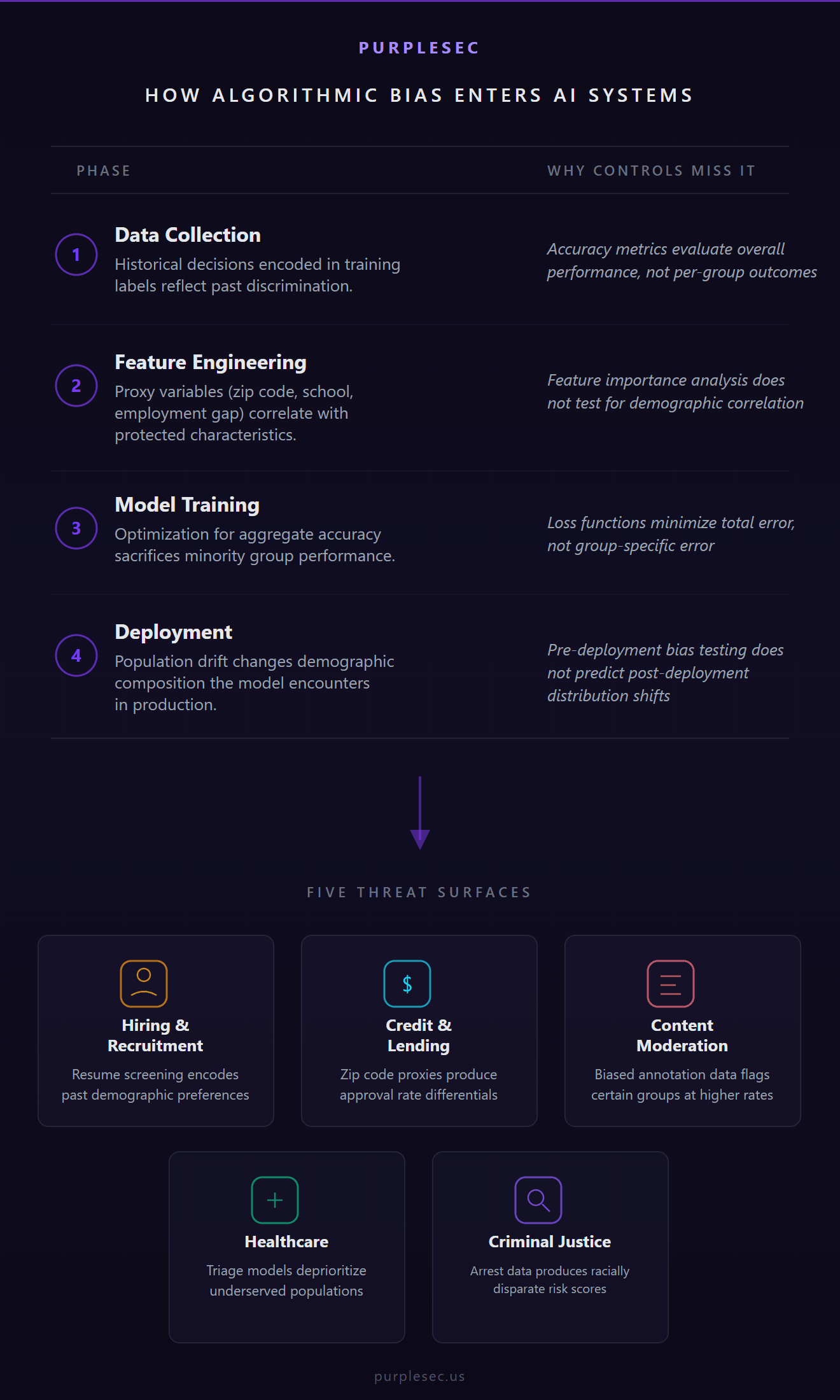
Algorithmic bias enters AI systems through three pathways.
Training data reflects historical patterns. Model architecture amplifies certain patterns over others. Deployment context introduces distribution shifts the model was not designed to handle.
Each pathway requires a different detection and mitigation strategy.
Phase | Attacker Action | Why Controls Miss It |
Reconnaissance | Test model capabilities and probe safety boundary edges. | Queries are indistinguishable from legitimate API evaluation. |
Capability Development | Craft prompts that elicit harmful outputs without triggering refusal. | No exploit signature exists. The interaction is syntactically valid. |
Weaponization | Generate phishing content, malware code, deepfakes, or disinformation. | Output matches the model’s standard response format. |
Delivery | Deploy AI-generated content across attack campaigns. | Volume exceeds manual production; each generated instance is unique. |
Algorithmic bias threatens five distinct surfaces:
- Hiring And Recruitment: Resume screening models trained on historical hiring data encode past demographic preferences. A model that never receives gender as an input can still discriminate through proxy variables.
- Credit And Lending: Credit scoring models that exclude race but include zip code produce approval rate differentials. Credit history gaps amplify racial disparities.
- Content Moderation: Language models trained on biased annotation data flag content from certain demographic groups at higher rates. Content suppression produces measurable harm to affected communities.
- Healthcare: Clinical decision support trained on historically unequal treatment data reproduces those inequities. Triage models can systematically deprioritize patients from underserved populations.
- Criminal Justice: Risk assessment models trained on arrest data produce racially disparate scores. Arrest data reflects policing patterns, not actual crime rates. The feedback loop between biased predictions and biased enforcement compounds over time.
Algorithmic Bias & Fairness
Bias can be intentional or emergent. Intentional bias exploits AI systems to produce discriminatory outcomes by design. Emergent bias arises from legitimate design choices that produce discriminatory effects. Both create equivalent legal exposure under disparate impact doctrine:
- Proxy Variable Exploitation: Zip code correlates with race. Employment gap correlates with pregnancy or disability. School name correlates with socioeconomic status. Removing protected characteristics does not remove discrimination when proxy variables remain in the feature set.
- Label Bias Propagation: Training labels generated from historical human decisions encode the biases of those decisions. A hiring model trained on “successful employees” inherits every demographic skew in the organization’s promotion history.
- Feedback Loop Amplification: AI systems that retrain on their own outputs create self-reinforcing bias. A content recommendation system that underserves a demographic group collects less engagement data from that group. The next training cycle further deprioritizes them.
- Distributional Shift Exploitation: Deploying a model in a demographic context different from its training data produces unpredictable fairness failures. A credit model trained on urban applicants may produce disparate outcomes when applied to rural populations.
- Fairness Metric Gaming: Optimizing for one fairness metric while ignoring others creates the appearance of compliance. A model tuned for demographic parity may violate equalized odds. The Impossibility Theorem of Fairness proves these metrics cannot all be satisfied simultaneously.
Example Of Algorithmic Bias & Fairness
A mid-size technology company deploys an AI resume screening tool for engineering positions. The model trains on five years of hiring data from the company’s existing engineering team.
The training data reflects the company’s historical hiring pattern: 82% male engineers. The model learns that male-correlated attributes predict “successful hire.” University programs, vocabulary patterns, and activities become selection signals.
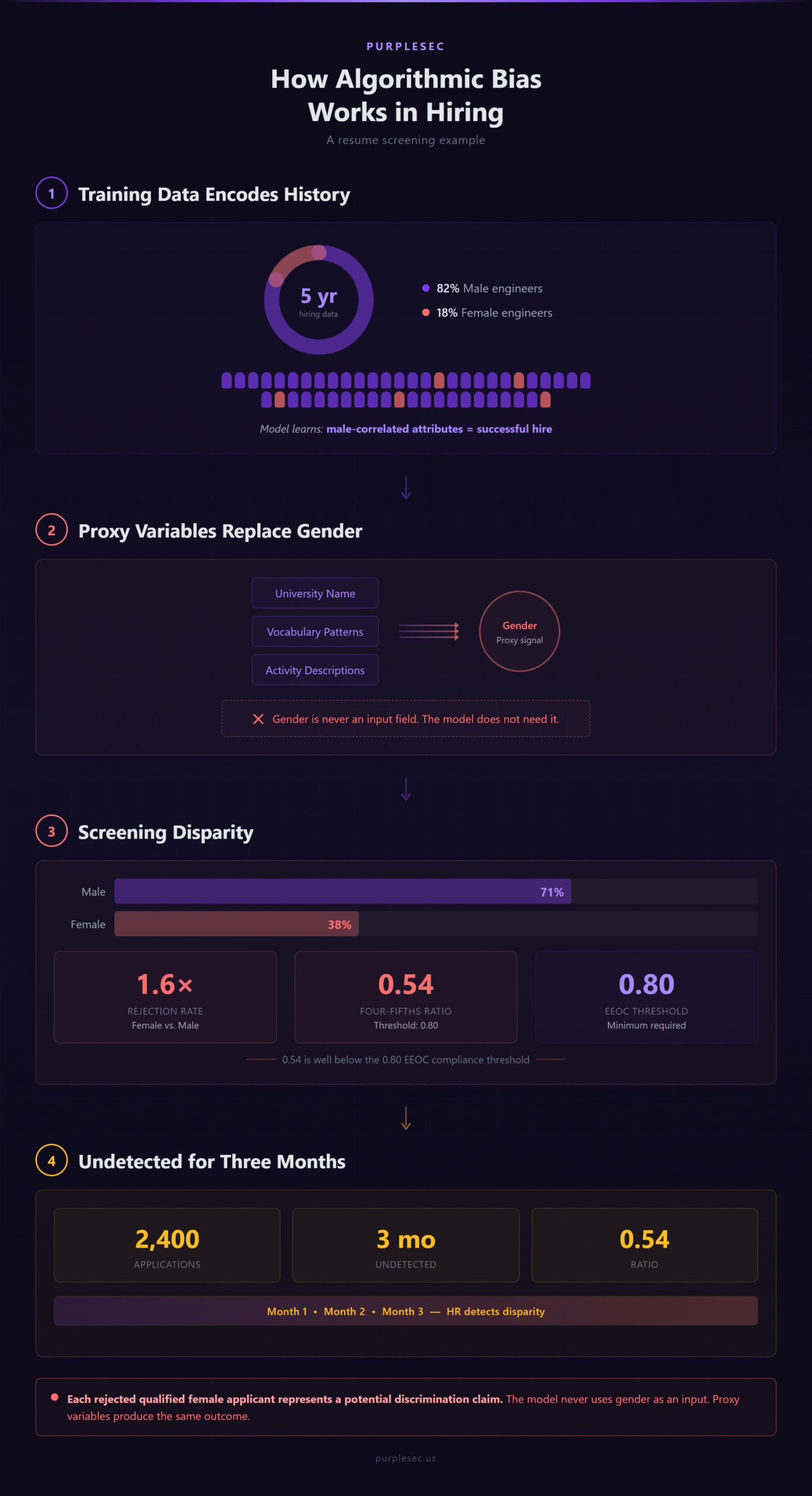
The model never receives applicant gender as an input. It does not need to.
University name, activity descriptions, and writing style serve as proxy variables.
The model screens out female applicants at 1.6 times the male rate. The selection rate for female applicants is 38%. The selection rate for male applicants is 71%. The four-fifths ratio is 0.54, well below the 0.80 EEOC threshold.
The HR team does not detect the disparity for three months. During that period, the model processes 2,400 applications. Each rejected female applicant who was qualified represents a potential discrimination claim.
LLM Resume Screening Bias: Real-World Impact Of Algorithmic Bias & Fairness
The hypothetical above mirrors what researchers have measured at scale.
In October 2024, Aylin Caliskan’s team at the University of Washington Information School tested three LLMs on resume ranking across 500 job listings, 120 name variations, and over 3 million comparisons. The full findings, published at the AAAI/ACM Conference on AI, Ethics, and Society, revealed systemic discrimination:
- LLMs favored white-associated names 85% of the time.
- Female-associated names were favored only 11% of the time.
- LLMs never favored Black male-associated names over white male-associated names.
These biases were not independent. Race and gender compounded.
A Brookings analysis of the same data confirmed that LLMs preferred white men even in female-majority occupations. A Black woman applying through an LLM-screened pipeline faces the combined penalty of both dimensions, not just one.
The BBQ benchmark, the standard framework for evaluating demographic bias in LLMs, found persistent bias across race, gender, religion, and disability.
No model achieved parity across all dimensions.
Detection And Defense
Detecting algorithmic bias requires statistical analysis of output distributions, not individual request inspection. WAFs, DLP, and RBAC cannot identify harm that emerges from aggregate model behavior.
Three control categories address algorithmic bias:
- Pre-Deployment Bias Testing: Run disparate impact analysis across all protected groups before any model reaches production. Document which fairness metric was selected and why.
- Continuous Fairness Monitoring: Bias is not a static property. Population drift, retraining cycles, and changing user behavior alter a model’s fairness profile after deployment. Monitor output distributions by demographic group on a defined cadence.
- Human-In-The-Loop Review: High-risk decisions affecting employment, credit, healthcare, and essential services require human oversight. Override rates below 1% indicate automation bias, not human agreement.

Intent-Based Detection
Intent-based detection extends bias defense beyond statistical testing. Keyword filters flag individual terms. They cannot distinguish legitimate queries from crafted bias exploits. The words are identical in both cases.
Intent analysis classifies the purpose behind each interaction. Traditional bias tools measure output distributions after the fact. Intent-based detection operates in real time during inference.
PromptShield™ is an intent-based AI security interaction layer that inspects prompts and responses before the model processes them. For algorithmic bias, this pre-execution inspection layer addresses the attack surface that statistical testing cannot reach — adversarial inputs crafted to trigger or amplify known model biases.
- Pre-Execution Interception: PromptShield™ inspects prompts and responses at the AI gateway before the model acts on them. Biased prompts (User-to-LLM), poisoned retrieval context (LLM-to-RAG), and discriminatory tool execution (LLM-to-Tools) are caught at the same inspection layer — not logged after the decision is made.
- Intent Analysis: Keyword filters cannot distinguish a legitimate query from an adversarial input crafted to exploit a known model bias. The words are identical. PromptShield™’s intent analysis classifies the purpose behind each interaction, catching manipulation patterns that signature-based detection misses.
- Governance: Every detection event produces a timestamped evidence record documenting what was detected, when, and what action was taken. Detection controls map to the PromptShield™ Risk Management Framework and PurpleSec AI Readiness Framework for audit-ready compliance.
- Tiered Enforcement: PromptShield™ deploys across three levels — L1 (presence detection), L2 (full detection and logging), and L3 (inline blocking). High-risk AI decisions affecting employment, credit, or healthcare require L3 enforcement where biased outputs are blocked before reaching downstream systems. Lower-risk contexts operate at L1/L2 for visibility without disrupting workflows.
"The detection challenge with algorithmic bias is that no single output is the violation. A biased model does not produce one wrong answer. It produces thousands of slightly skewed answers that, in aggregate, violate fairness standards. That is why PromptShield™ inspects at the interaction level rather than the output level. Intent analysis catches the adversarial trigger before the model generates the biased response."
Joshua Selvidge, CTO, PurpleSec
Secure Every AI Interaction With PromptShield™
Understand the why behind every prompt, response, and agent action in real time, so you can confidently audit, question, and govern AI.
Contents

Free AI Readiness Assessment
Implement AI faster with confidence. Identify critical gaps in your AI strategy and align your security operations with your deployment goals.
Frequently Asked Questions
What Is The Difference Between Algorithmic Bias And Algorithmic Fairness?
Algorithmic bias is the measurable disparity in AI outputs across demographic groups. Algorithmic fairness is the standard for evaluating those disparities. Bias is the problem. Fairness is the benchmark. Organizations need both concepts. Detecting bias requires choosing a fairness metric first. The metric choice determines what counts as biased.
Can Removing Protected Characteristics From Training Data Eliminate Bias?
No. The vendor is responsible for the model’s base safety constraints. The deploying organization owns access control, API credential management, and acceptable use enforcement at the application layer. LLMjacking attacks exploit the deploying organization’s credentials. The vendor processes those requests as legitimate. In AI as in cloud, the provider secures the model. The deploying organization secures access to it.
What Is The EEOC Four-Fifths Rule For AI
The clearest early signal is cost anomaly: unexplained inference spend tied to a specific API key or IAM role. Secondary signals include request volume spikes outside business hours and high refusal rates from a single source. Access from unfamiliar IP ranges warrants immediate review. Misuse rarely looks like an attack in logs. It looks like a heavy user with unusual output patterns.
Can An AI System Be Fair On All Metrics Simultaneously?
Shadow AI refers to tools accessed without IT knowledge or approval. It removes every control the organization would otherwise apply: access logging, content filtering, acceptable use enforcement. Employees entering sensitive data into unsanctioned AI services create both a data exposure risk and a misuse surface. The organization has no visibility into either.
What Happens If Bias Is Detected In A Production AI System?
Intent is rarely visible in logs. The operational distinction is pattern. A single harmful request is more likely accidental. Repeated requests that probe the same prohibited output category, escalate specificity, or arrive outside normal usage windows suggest intent. Detection systems should flag patterns, not isolated events.
How Often Should AI Systems Be Tested For Bias?
Revoke the API credential or session immediately. Do not begin forensic investigation first. Active misuse at scale can generate significant cost exposure and harmful output volume within minutes. After containment, preserve the full request log before rotating credentials. Log integrity is the primary evidence chain for internal investigation and regulatory notification obligations.
Related Terms
Bias often originates in training data. Adversarial data poisoning can deliberately amplify bias as an attack vector.
Regulatory Non-Compliance
Biased AI decisions directly violate anti-discrimination provisions in regulations like the EU AI Act and sector-specific laws.
Bias cannot be identified or corrected without the ability to audit model decisions and trace them back to data and design choices.
Publicized bias in an organization’s AI system causes immediate reputational and trust damage with customers and regulators.