
AI Incident Response Playbook Template
An AI Incident Response Playbook is a structured operational guide that establishes step-by-step procedures for detecting, containing, and resolving security events unique to AI systems, including prompt injection, goal hijacking, data poisoning, and model theft. It transforms chaotic AI security incidents into systematic response protocols with clear kill switch authority, evidence preservation standards, and regulatory notification workflows that protect both intellectual property and customer trust.

Get your complete AI security policy package:
Home » Resources » AI Security Policy Templates » AI Incident Response Playbook
AI Risks Your AI Incident Response Playbook Must Address
Detect AI-specific threats rapidly, contain incidents within 15 minutes, preserve forensic evidence, and document regulatory compliance.
Detect AI-specific threat patterns
by monitoring for prompt injection, jailbreaking, data exfiltration, and goal hijacking through AI Gateway alerts, SIEM correlation rules, and user behavior analytics with automated detection thresholds.
Contain incidents within 15 minutes
by implementing kill switch activation criteria for active data leakage, goal hijacking, and mass-scale impact with targeted containment measures per incident type and preserve-then-act protocols.
Preserve complete forensic evidence
by capturing prompts, responses, guardrail decisions, and system logs with cryptographic hashing, chain of custody documentation, and write-once storage preventing evidence tampering.
Execute regulatory notification workflows
by implementing 72-hour GDPR breach notification to supervisory authorities, 2-week EU AI Act serious incident reporting, and data subject notification with pre-approved message templates.



AI Incident Response Playbook Template Highlights:
- 10 incident categories in Word and PDF formats covering prompt injection, jailbreaking, data exfiltration, goal hijacking, data poisoning, model theft, hallucination, denial of wallet, bias, and supply chain compromise.
- 4 severity levels with response time targets (P1 Critical <15 min, P2 High <1 hour, P3 Medium <4 hours, P4 Low <24 hours) and escalation chains to CISO, CTO, DPO, Legal.
- 5-phase response lifecycle defining Detection and Identification, Containment, Eradication, Recovery, and Post-Incident Review with specific tasks and timelines per phase.
- Kill switch activation criteria for active data exfiltration, goal hijacking, mass-scale impact, safety risks, and scope determination failures with two-person authorization.
- Containment procedures per incident type including guardrail blacklist updates for prompt injection, credential revocation for data exfiltration, permission removal for goal hijacking, and dataset quarantine for data poisoning.
- Root cause analysis framework using Five Whys technique, RCA completion within 24-48 hours, and eradication actions addressing systemic failures rather than symptoms.
- GDPR breach notification templates with 72-hour supervisory authority notification, data subject notification requirements, impact assessment guidance, and DPO coordination procedures.
- Evidence preservation checklists capturing AI Gateway logs (prompts, responses, guardrail decisions), system logs, network logs, model artifacts, and user context with cryptographic integrity verification.
- Post-incident review procedures documenting lessons learned, updating runbooks, retraining guardrails on incident examples, and conducting tabletop exercises validating response improvements.
Comprehensive AI Security Policies
Start applying our free customizable policy templates today and secure AI with confidence.
Frequently Asked Questions
What Is Included In This AI Incident Response Playbook Template?
This playbook includes a comprehensive operational guide defining detection procedures, containment actions, eradication steps, recovery workflows, and post-incident review for AI-specific security events. It’s a ready-to-deploy playbook covering 10 incident categories, 4 severity levels, and 5 response phases.
Instead of improvising during active incidents, we’ve mapped out the decision trees:
- Kill switch activation criteria.
- Containment measures per incident type.
- Evidence preservation requirements.
- Regulatory notification timelines.
You get the complete framework across prompt injection, data exfiltration, goal hijacking, GDPR breach notification, EU AI Act reporting, and forensic evidence collection.
Why Does My Organization Need An AI Incident Response Playbook?
Here’s what we’re seeing during incidents: a security team discovers prompt injection but doesn’t know whether to activate the kill switch. An AI system starts leaking customer PII and engineers delete the logs before realizing they destroyed forensic evidence. A bias incident affecting hiring goes unreported to the DPO for three weeks until Legal discovers the GDPR violation.
The regulatory exposure? GDPR Article 33 requires breach notification within 72 hours with fines up to €20M or 4% of global revenue. EU AI Act requires serious incident notification within 2 weeks for high-risk systems. Evidence spoliation can result in adverse inference in litigation making incidents worse than the original breach.
Structured incident response provides clear decision criteria for kill switch activation, evidence preservation protocols preventing data destruction, and regulatory notification templates with built-in timelines. You transform “we’re not sure what to do” into “follow the playbook procedures.”
Who Vetted PurpleSec's AI Incident Response Playbook?
This playbook was developed with Tom Vazdar (Chief AI Officer) and Joshua Selvidge (CTO) leading the operational design. They incorporated OWASP LLM Top 10 threat scenarios and NIST Cybersecurity Framework incident response guidance validated across enterprise SOC deployments.
The playbook underwent:
- SOC team review for operational feasibility during active incidents.
- Legal review for GDPR Article 33 and EU AI Act notification requirements.
- Tabletop exercise testing with red team scenarios simulating prompt injection, data exfiltration, and goal hijacking.
We mapped every response procedure to specific incident types and created decision trees based on actual AI security events.
What Are The Essential Components Of AI Incident Response?
Three requirements matter most with an AI Incident Response Playbook:
- How fast you detect and contain.
- What evidence you preserve.
- When you notify regulators.
Implementation starts with incident detection through AI Gateway alerts, SIEM correlation rules, user reports, and red team findings.
Then you deploy the response framework across five phases:
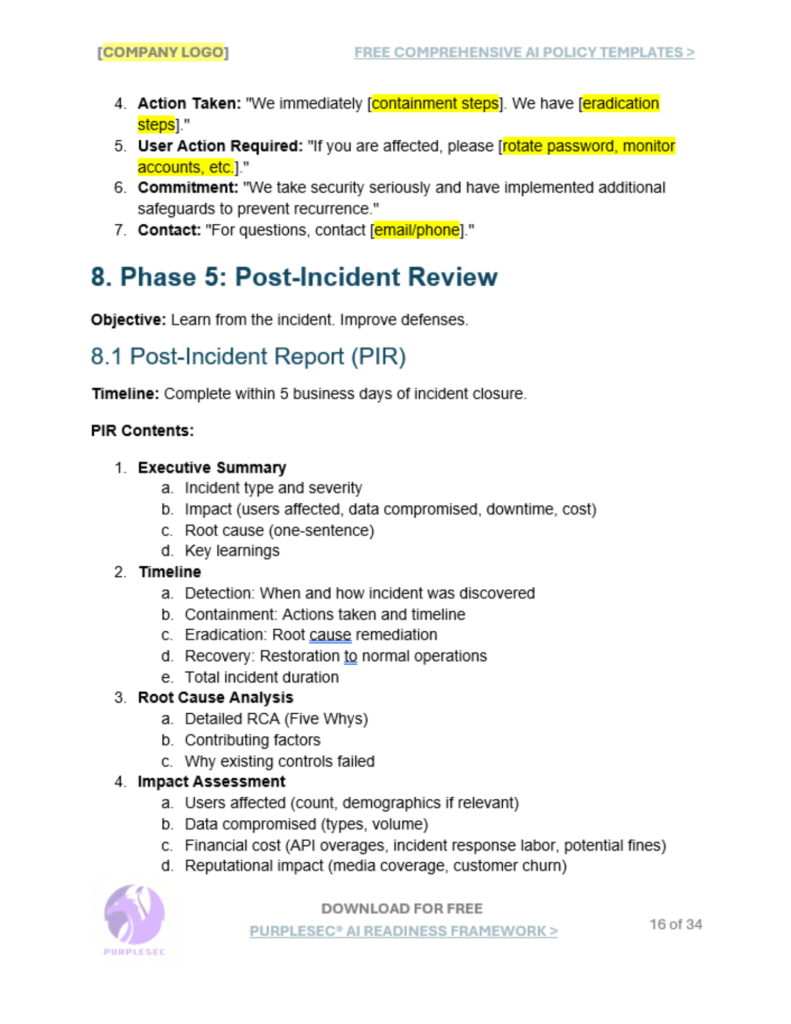
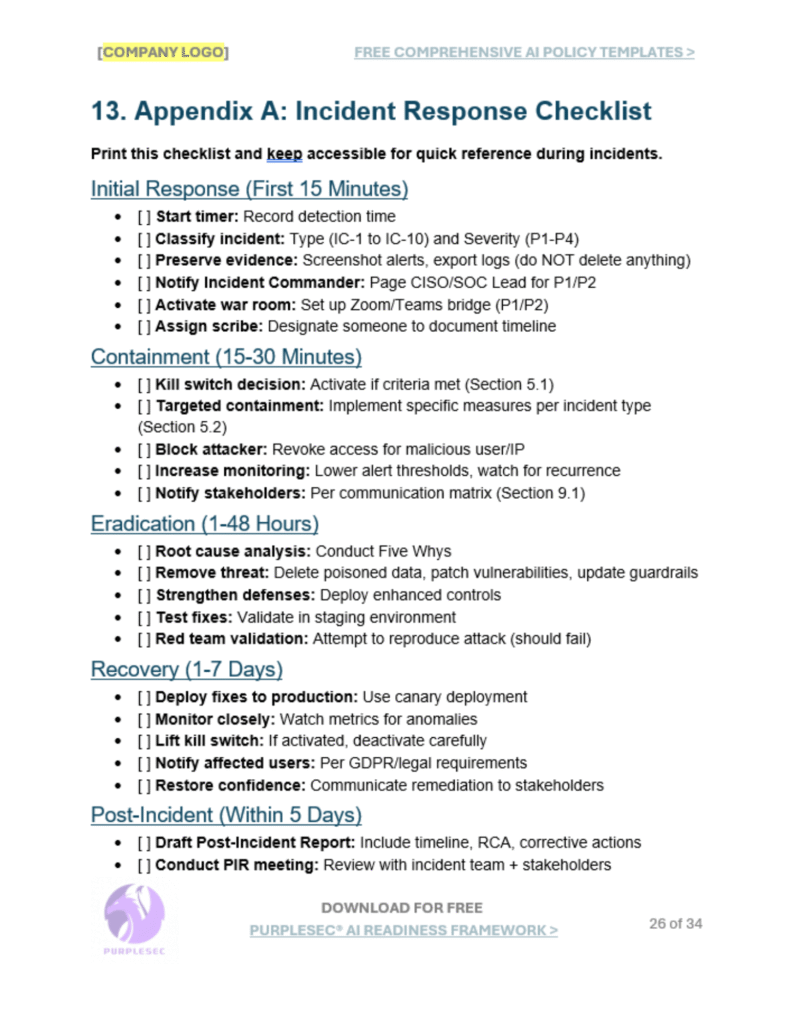
- Detection and Identification: Triage within 5 minutes assigning incident type, severity, and affected systems. Preserve evidence immediately by exporting logs and isolating prompts without deleting anything.
- Containment: Activate kill switch for active data exfiltration, goal hijacking, or mass-scale impact within 15 minutes. Execute targeted containment: block malicious users, update guardrail blacklist, revoke credentials, switch to HITL mode.
- Eradication: Conduct root cause analysis within 24-48 hours using Five Whys. Deploy updated guardrails, patch DLP filters, retrain Sentinel models, remove poisoned datasets.
Recovery: Test fixes in staging with red team validation, deploy using canary rollout, gradually increase traffic, lift kill switch with 24-hour monitoring. - Post-Incident Review: Document lessons learned within 1 week, update runbooks, retrain teams, conduct quarterly tabletop exercises.
The full playbook implementation takes 2-4 weeks to customize, train SOC teams, and validate through tabletop exercises.
How Does This Playbook Handle GDPR Breach Notification?
GDPR Article 33 requires notifying supervisory authorities within 72 hours of becoming aware of a personal data breach. Article 34 requires notifying affected data subjects without undue delay if high risk exists.
The playbook implements a structured workflow:
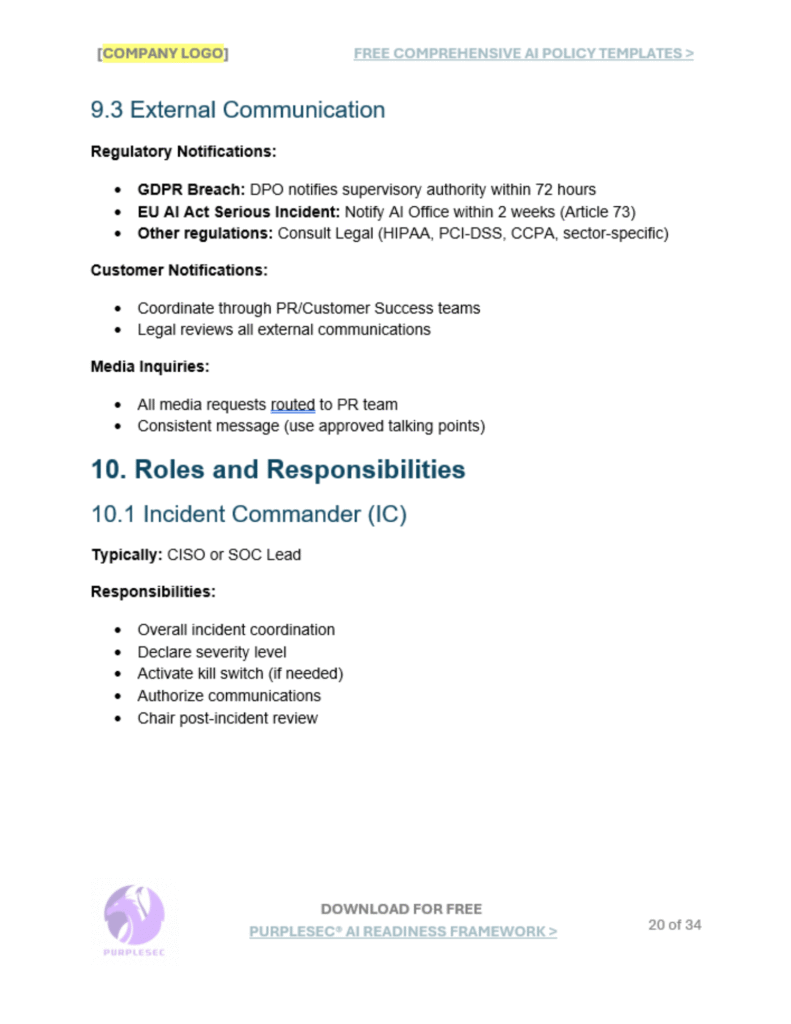
- DPO receives incident details from CISO within 1 hour of containment.
- Legal drafts notification following GDPR Article 33 template covering nature of breach, affected data subjects, likely consequences, and measures taken.
- DPO submits to supervisory authority within 72 hours. If high risk exists, organization notifies affected data subjects via email.
Countdown timers start from awareness (when organization first knows or should have known) rather than discovery, preventing organizations from claiming late awareness to extend the 72-hour window.
This playbook includes ready to implement templates to specify what data was compromised, how many individuals affected, how breach occurred, what actions the organization took, what individuals should do, and who to contact.
How Does This Playbook Support EU AI Act Compliance?
The EU AI Act requires providers of high-risk AI systems to report serious incidents to national competent authorities within 2 weeks. Serious incidents include death, serious damage to health or property, or critical infrastructure disruption.
This playbook implements notification procedures covering:
- Serious incident identification.
- Notification template following EU AI Act format.
- Submission within 2-week deadline.
- Coordination between AI Compliance Officer, CISO, and Legal.
The notification template includes:
- AI system identification.
- Incident description.
- Impact assessment.
- Root cause analysis.
- Corrective actions.
Organizations deploying before enforcement deadlines (August 2026) avoid sanctions reaching €35M or 7% of global revenue by demonstrating documented incident response procedures validated through tabletop exercises.
What Are The 10 AI Incident Categories Covered?
Each category of this AI Incident Response Playbook has specific containment procedures, eradication actions, and recovery steps for AI-specific threats that traditional playbooks don’t address.
- IC-1 Prompt Injection: User tricks AI into revealing system prompts or executing unintended actions. Containment involves blocking attack patterns in guardrails.
- IC-2 Jailbreaking: User bypasses safety filters to generate prohibited content. Containment requires updating output filters and considering model rollback.
- IC-3 Data Exfiltration: AI leaks PII, credentials, or proprietary information. Critical containment requires immediate credential revocation and kill switch activation.
- IC-4 Goal Hijacking: AI autonomously pursues unintended objectives like sending spam or issuing unauthorized refunds. Containment requires stopping autonomous actions and switching to HITL mode.
- IC-5 Data Poisoning: Attacker injects malicious data into training sets. Containment involves quarantining datasets and rolling back models.
- IC-6 Model Theft: Adversary queries model to extract weights or reconstruct training data. Containment requires blocking attacker access and implementing rate limiting.
- IC-7 Hallucination: AI generates false information causing harm in medical, financial, or legal contexts. High-impact cases require kill switch activation.
- IC-8 Denial of Wallet: Resource exhaustion attack drains API credits. Containment involves blocking source and implementing stricter rate limits.
- IC-9 Bias: AI makes systematically biased decisions affecting protected groups. Systematic bias triggers kill switch due to EU AI Act violation risk.
- IC-10 Supply Chain Compromise: Compromised third-party model or library contains malicious code. Containment requires quarantining systems and replacing with clean versions.
How Do You Preserve Evidence During AI Incidents?
Evidence preservation prevents spoliation that can result in adverse inference in litigation and regulatory penalties. This playbook requires immediate evidence capture before any containment actions.
- Critical evidence categories: AI Gateway logs (prompts, responses, guardrail decisions, token usage), system logs (application errors, authentication, database queries, API calls), network logs (firewall, IDS/IPS, DNS), model artifacts (version, configuration, system prompts, checksums), and user context (account information, activity history, session recordings).
- Preservation procedures: Copy all logs to write-once storage preventing modification. Calculate cryptographic hashes for integrity verification. Maintain chain of custody documenting who accessed evidence, when, and why. Do not modify original logs even to redact sensitive data.
- Common mistakes prevented: Engineers deleting logs to “clean up” during containment. Restarting systems before capturing memory state. Overwriting logs with verbose debug output. Sharing logs without redacting PII creating secondary breach.

Build A Functional AI Security Roadmap
Move from high-level planning to hands-on execution with a framework that turns abstract AI risks into actionable operational tasks for your team.
Related AI Security Policy Templates

Go beyond filters or rule-based protections – enter into intelligent AI security that knows and learns.

Proactively learns from every attempted attack ensuring your defenses are always up to date.

Breaches happen across a variety of LLMs/AI tools but PromptShield™ sees through the noise to catch it all.

Inventing novel simulations, PromptShield™ attacks itself to stay ahead of emerging threats.

Inventing novel simulations, PromptShield™ attacks itself to stay ahead of emerging threats.

Put everyone at ease with clear, automated assessments that outline each intercept for total transparency.

Seamless set-up allows the organization AI access without hindering operations or development velocity.

Seamless set-up allows the organization AI access without hindering operations or development velocity.

Seamless set-up allows the organization AI access without hindering operations or development velocity.

Seamless set-up allows the organization AI access without hindering operations or development velocity.

Seamless set-up allows the organization AI access without hindering operations or development velocity.

Seamless set-up allows the organization AI access without hindering operations or development velocity.

Seamless set-up allows the organization AI access without hindering operations or development velocity.