
AI Model Development Lifecycle (AI MDLC) Policy Template
An AI Model Development Lifecycle Policy Template (AI MDLC) is a governance framework that establishes mandatory requirements across seven distinct phases: ideation, data acquisition, model development, validation, deployment, monitoring, and retirement. This ensures systematic, reproducible, and auditable AI model creation. This policy template integrates security, privacy, fairness, and ethics requirements at every lifecycle stage while maintaining regulatory compliance with EU AI Act, GDPR, and sector-specific requirement.

Get your complete AI security policy package:
Home » Resources » AI Security Policy Templates » AI Model Development Lifecycle
Essential Risks Your AI MDLC Must Address
Uncontrolled model development creates systemic vulnerabilities where biased training data, inadequate testing, and absent monitoring protocols deploy discriminatory or insecure AI systems into production.
Prevent biased model deployment
by implementing mandatory fairness testing using the Four-Fifths Rule (80% disparate impact threshold), disaggregated performance analysis measuring accuracy across demographic groups, and pre-deployment bias audits requiring AI Governance Committee approval for high-risk models before production release.
Eliminate model reproducibility failures
with experiment tracking systems logging code versions, hyperparameters, data versions, training environments, and performance metrics for every training run, enabling teams to recreate any historical model and satisfy regulatory audit requirements.
Close security gaps in training
through data provenance documentation tracking every data source’s collection method and licensing status, adversarial robustness testing measuring Attack Success Rate below 5%, and model weight protection using cryptographic signing preventing tampering.
Establish continuous performance monitoring
by implementing drift detection comparing current feature distributions against training data, quarterly fairness audits measuring disparate impact ratios, and scheduled retraining protocols triggered when performance drops below defined thresholds.




AI MDLC Policy Template Highlights
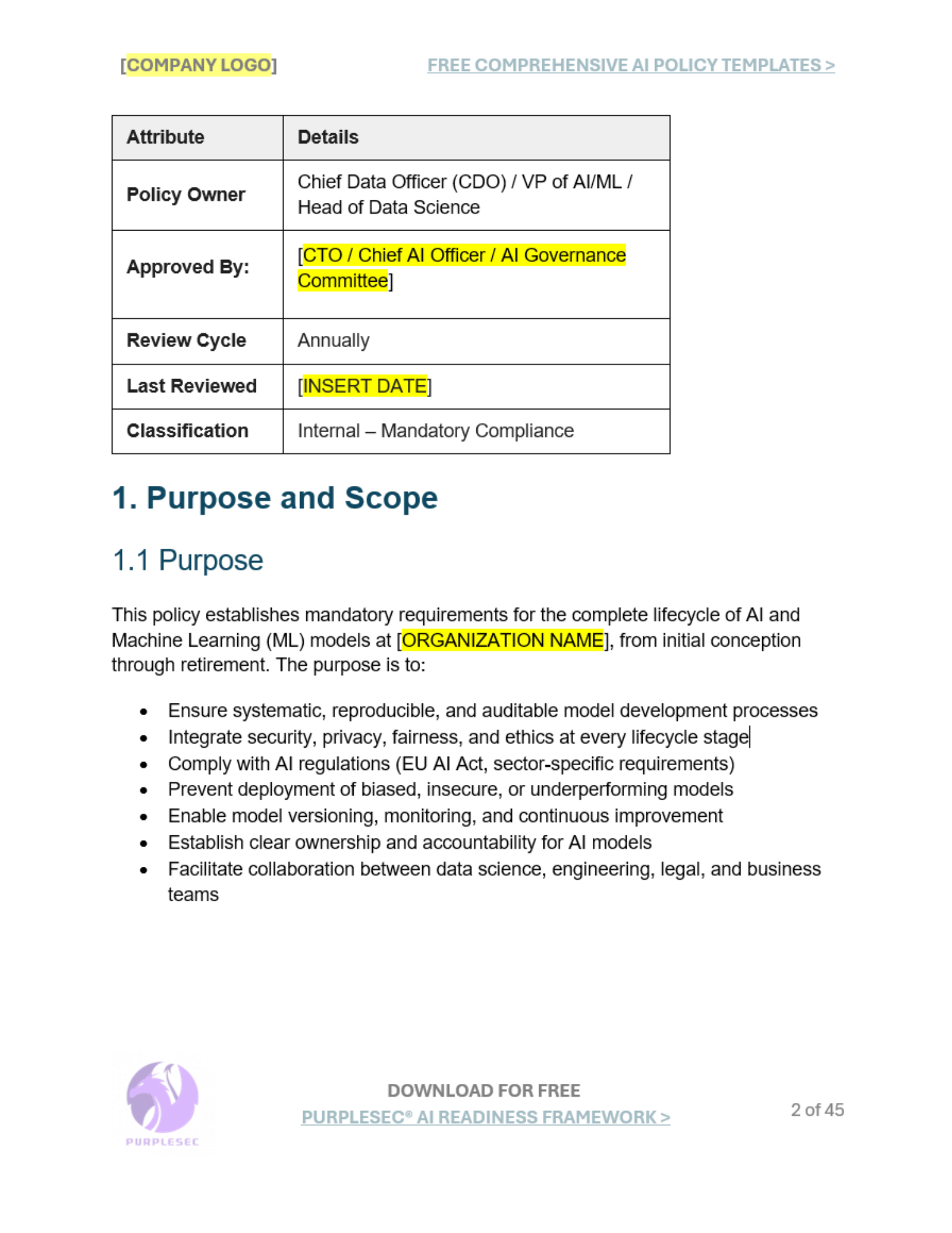
- Editable AI Model Development Lifecycle Policy Template available in Word and PDF formats defining seven mandatory phases with specific deliverables and approval authorities.
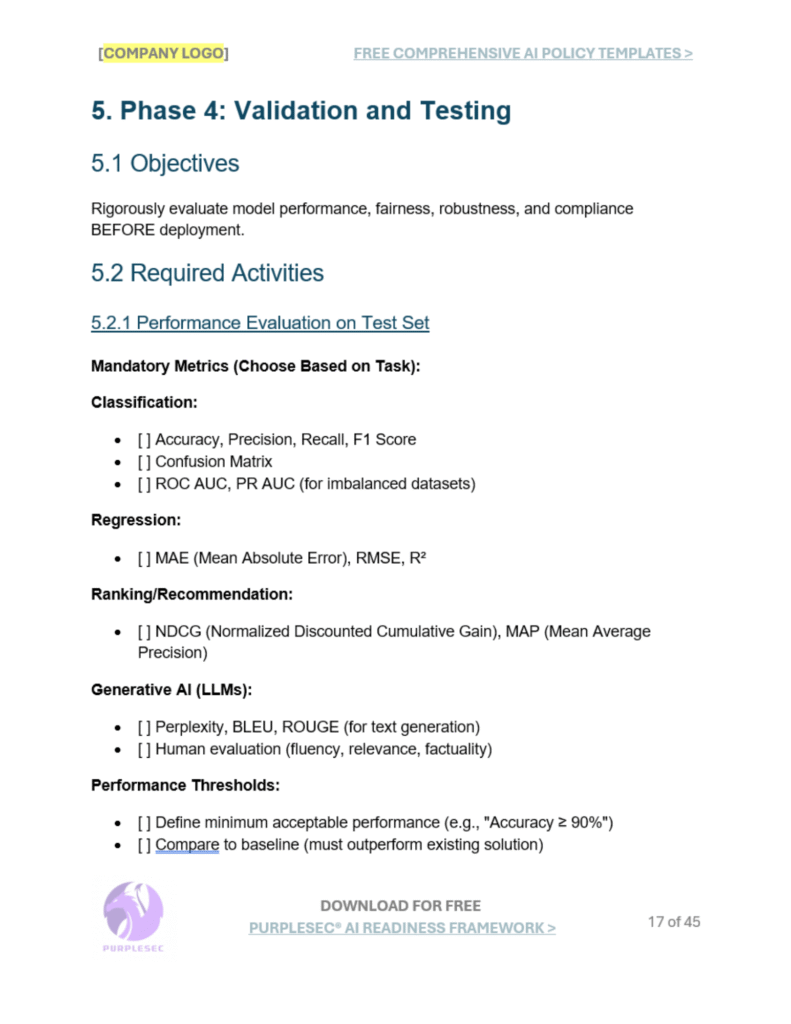
Seven-phase lifecycle framework covering ideation and scoping, data acquisition, model development, validation and testing, deployment, monitoring and maintenance, and retirement with documented phase gates. - Business Impact Analysis templates requiring problem statements, success metrics, baseline performance, and stakeholder identification before development begins.
- Data-BOM (Bill of Materials) framework documenting data sources, collection methods, licensing status, copyright compliance, personal data handling, and quality issues for every training dataset.
Fairness testing protocols including Four-Fifths Rule disparate impact analysis, disaggregated performance evaluation across demographic groups, and bias mitigation strategies for models failing fairness thresholds. - Experiment tracking requirements mandating MLflow or equivalent systems logging code versions, hyperparameters, data versions, training metrics, and artifacts for reproducibility and audit compliance.
- Multi-stage deployment strategy using shadow mode, canary deployment, and gradual rollout with automated rollback triggers preventing production incidents from untested models.
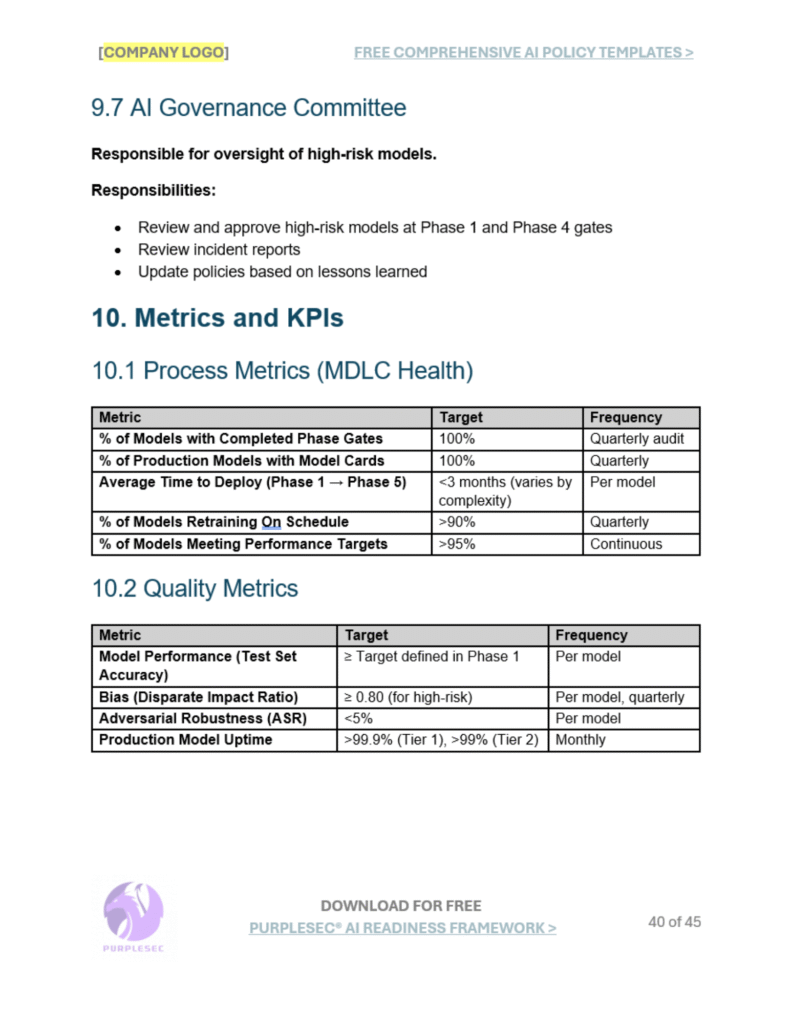
- Drift detection and monitoring implementing statistical tests for data drift, concept drift, and prediction drift with defined response protocols for minor, moderate, and severe performance degradation.
- Model Card documentation providing public-facing transparency on intended use, training data, performance metrics, fairness testing results, limitations, and ethical considerations.
- Retirement procedures defining archival requirements (10-year retention for model weights and documentation), access revocation, and post-retirement monitoring preventing unexpected dependencies.
- Role-based responsibility matrix assigning Model Owner, Data Scientist, MLOps, DPO, Legal, Business Sponsor, and AI Governance Committee with specific lifecycle accountabilities.
Comprehensive AI Security Policies
Start applying our free customizable policy templates today and secure AI with confidence.
Frequently Asked Questions
What Is Included In This AI Model Development Lifecycle Policy Template?
We built this template to give you a clear roadmap for developing AI models without accidentally deploying biased or insecure systems into production. It’s a ready-to-deploy framework that guides teams through seven mandatory phases, establishes testing requirements before deployment, and ensures proper documentation for regulatory compliance.
The template includes:
- Business Impact Analysis templates defining problem statements and success metrics before development begins.
- Data-BOM frameworks documenting every training data source with licensing and copyright status.
- Experiment tracking checklists requiring version control for all training runs.
- Fairness testing methodologies using Four-Fifths Rule calculations.
- Phased deployment strategies with shadow mode and canary rollout procedures.
- Model Card templates for transparency compliance.
- Drift detection protocols triggering retraining when performance degrades.
Why Does My Organization Need An AI MDLC Policy?
Without structured lifecycle governance, data science teams deploy models that haven’t been tested for bias, lack documentation for regulatory audits, and cannot be reproduced when questions arise months later.
A recommendation model generating discriminatory outcomes cannot be investigated if no one documented which training data was used, what fairness tests were performed, or who approved deployment.
- The EU AI Act requires systematic risk management for high-risk AI systems throughout their lifecycle.
- GDPR Article 22 requires meaningful information about automated decision-making logic.
- Financial regulators expect model validation documentation.
Without a formal AI MDLC policy, organizations cannot demonstrate compliance during regulatory reviews or defend models during discrimination investigations.
Model drift also degrades performance silently. A fraud detection model trained on 2023 transaction patterns loses accuracy as payment methods evolve, but without monitoring protocols, this degradation goes undetected until customer complaints escalate. Scheduled retraining and continuous performance evaluation prevent production failures from undetected drift.
Who Vetted PurpleSec's AI AI MDLC Policy Template?
Tom Vazdar, PurpleSec’s Chief AI Officer, developed this template with review by Joshua Selvidge, Chief Technology Officer, with 15+ years securing enterprise AI deployments across financial services, healthcare, and government sectors.
This framework aligns with:
- EU AI Act lifecycle requirements.
- GDPR automated decision-making provisions.
- NIST AI Risk Management Framework.
- ISO/IEC 23894 AI risk management guidance.
It incorporates fairness testing methodologies from the EEOC Four-Fifths Rule and model governance practices from financial sector model risk management standards.
What Are The Essential Components Of An AI MDLC Policy?
An effective AI MDLC policy must establish phase gates that prevent teams from skipping critical steps. Here are the components that matter:
Phase gates with mandatory approvals:
- Each phase requires specific deliverables before proceeding.
- Phase 1 needs Problem Statement Document and Risk Classification Matrix.
- High-risk models require AI Governance Committee sign-off, not just team approval.
- Without documented objectives, teams build models that don’t solve actual business problems.
Data governance and provenance tracking:
- Data-BOM documents every training data source: where it came from, legal rights to use it, personal data status.
- Prevents GDPR violations and copyright infringement that surface. months after deployment.
- DPO approval for personal data and Legal approval for third-party data are mandatory before training.
Fairness testing with defined thresholds:
- Four-Fifths Rule requiring selection rates ≥0.80 across protected groups.
- Accuracy parity within 5% across demographic groups.
- Mandatory bias mitigation before deployment.
- Models failing these tests don’t go to production regardless of business pressure.
Experiment tracking for reproducibility:
- Every training run logs Git commit hash, hyperparameters, data version, environment, metrics, timestamp.
- Uses MLflow or equivalent systems.
- When regulators ask how a model was trained six months ago, teams can recreate it exactly.
Phased deployment strategy:
- Shadow mode runs models in parallel without affecting customers.
- Canary deployment tests on 5-10% of traffic with automated rollback.
- Gradual rollout increases traffic only after each stage proves stable.
- Transforms risky big-bang deployments into controlled releases.
Monitoring and retraining protocols:
- Drift detection compares current data against training distributions.
- Quarterly fairness audits verify high-risk models maintain compliance.
- Scheduled retraining every 6-12 months prevents models from becoming stale.
- Without these mechanisms, model performance degrades silently.
How Does This AI MDLC Policy Address EU AI Act Compliance?
High-risk AI classification during Phase 1 identifies models used in employment, credit scoring, law enforcement, critical infrastructure, education, or essential services requiring strict EU AI Act requirements. These models undergo enhanced risk assessment, mandatory fairness testing, explainability requirements, and AI Governance Committee approval.
- Article 15 resilience requirements are satisfied through adversarial robustness testing measuring Attack Success Rate below 5%, input validation preventing adversarial examples, and circuit breakers stopping predictions when error rates exceed thresholds. Deployment strategies using shadow mode and canary deployments provide fault tolerance.
- Article 13 transparency requirements are met through Model Cards documenting intended use, capabilities, limitations, performance, and human oversight mechanisms. Explainability reports using SHAP or LIME provide local explanations for individual predictions on high-risk automated decisions.
- Article 53 training data transparency requires Data-BOM documentation tracking all data sources, copyright status, and compliance with robots.txt and opt-out requests for foundation models trained on web data. Legal review verifies licensing permits ML training use.
How Does This AI MDLC Policy Support GDPR Compliance?
GDPR compliance requires balancing automated efficiency with individual rights to explanation, erasure, and human review. This policy addresses these requirements by following:
- GDPR Article 22 restricts automated decisions producing legal effects on individuals. The policy addresses this through mandatory human-in-the-loop for high-risk decisions. Loan approvals, employment decisions, and credit scoring cannot be fully automated without human review. Models flag borderline cases for human underwriters who can override AI recommendations.
- Right to explanation requires providing meaningful information about automated decisions. Model Cards document the logic, performance metrics, and fairness results. Organizations must explain decisions using SHAP or LIME in plain language: “credit score of 620 is below our 650 threshold” rather than technical jargon like “SHAP value of -0.34.”
- Right to erasure creates technical challenges. You cannot surgically remove one person’s data from a trained neural network. Solutions include retraining models without that individual’s data (expensive but compliant) or demonstrating the data was sufficiently anonymized that deletion isn’t required. The policy requires purging data from training datasets, inference logs, and monitoring systems within documented timelines.
- Data minimization prevents collecting data “just in case.” The Data-BOM framework requires justifying why each data field is necessary. Collecting birth date when you only need age range violates minimization. Retention limits must be defined during Phase 2: will training data be deleted after deployment, kept for retraining, or retained for audits? Default retention “forever” violates GDPR.

Build A Functional AI Security Roadmap
Move from high-level planning to hands-on execution with a framework that turns abstract AI risks into actionable operational tasks for your team.
Related AI Security Policy Templates

Go beyond filters or rule-based protections – enter into intelligent AI security that knows and learns.

Proactively learns from every attempted attack ensuring your defenses are always up to date.

Breaches happen across a variety of LLMs/AI tools but PromptShield™ sees through the noise to catch it all.

Inventing novel simulations, PromptShield™ attacks itself to stay ahead of emerging threats.

Inventing novel simulations, PromptShield™ attacks itself to stay ahead of emerging threats.

Put everyone at ease with clear, automated assessments that outline each intercept for total transparency.

Seamless set-up allows the organization AI access without hindering operations or development velocity.

Seamless set-up allows the organization AI access without hindering operations or development velocity.

Seamless set-up allows the organization AI access without hindering operations or development velocity.

Seamless set-up allows the organization AI access without hindering operations or development velocity.

Seamless set-up allows the organization AI access without hindering operations or development velocity.

Seamless set-up allows the organization AI access without hindering operations or development velocity.

Seamless set-up allows the organization AI access without hindering operations or development velocity.