
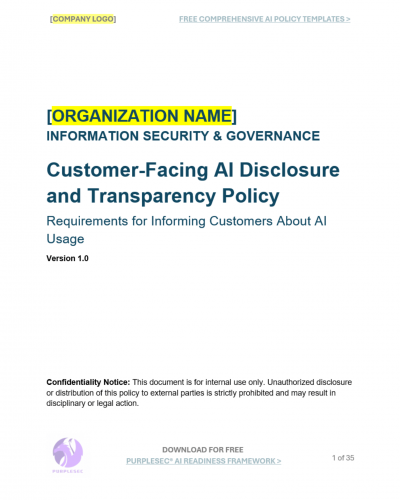
Customer-Facing AI Disclosure And Transparency Policy Template
A Customer-Facing AI Disclosure and Transparency Policy Template is a customizable governance document that establishes mandatory requirements for informing customers about AI usage, defining disclosure timing and placement, labeling AI-generated content, and requiring human escalation options. This policy transforms hidden AI usage into transparent customer interactions while preventing FTC deceptive practice violations, EU AI Act transparency penalties, and customer trust erosion.
Get your complete AI security policy package:
Home » Resources » AI Security Policy Templates » Customer-Facing AI Disclosure
Essential Risks Your AI Disclosure Policy Must Address
Disclose AI interactions before engagement, label AI-generated content clearly, enable automated decision explanations, and provide human escalation.
Disclose chatbot AI identity upfront
by requiring disclosure at first interaction, displaying persistent visual indicators, providing clear escalation to human agents, and prohibiting human impersonation using deceptive names.
Label all AI-generated content
by watermarking AI-generated images, including bylines on AI-written articles, overlaying AI video with synthetic media warnings, embedding C2PA metadata for deepfakes, and obtaining consent for likeness usage.
Streamline customer review requests
by disclosing automated decision-making in privacy policies, providing point-of-decision notifications, enabling Right to Contest with human review, offering explanations of AI logic within 30 days, and implementing human-in-the-loop for high-impact decisions.
Meet specialized requirements for regulated industries
by placing disclosures at or before point of interaction, meeting WCAG AA contrast requirements, using minimum 10-12pt font size, writing in plain language at 8th-grade reading level, and maintaining multi-platform consistency.
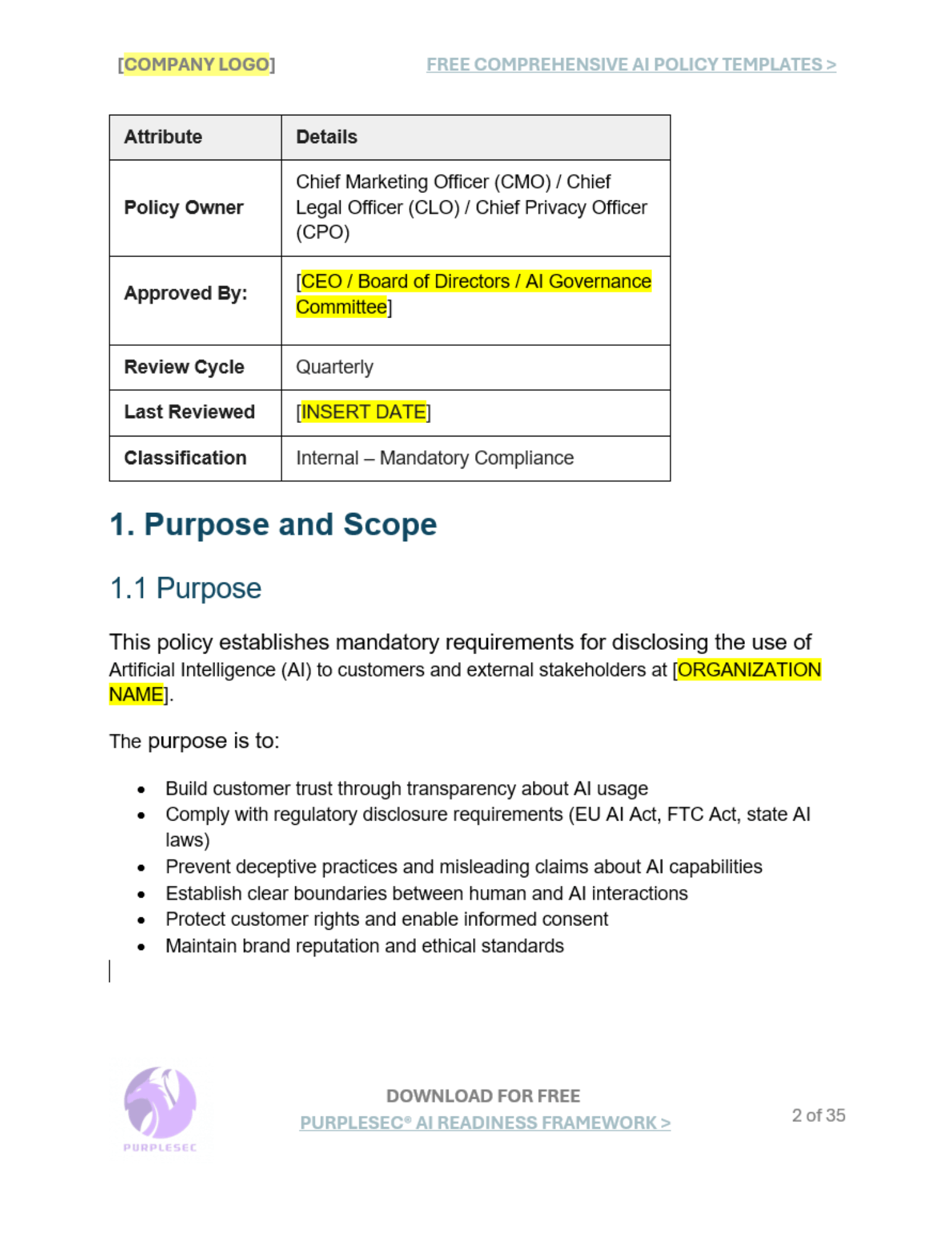

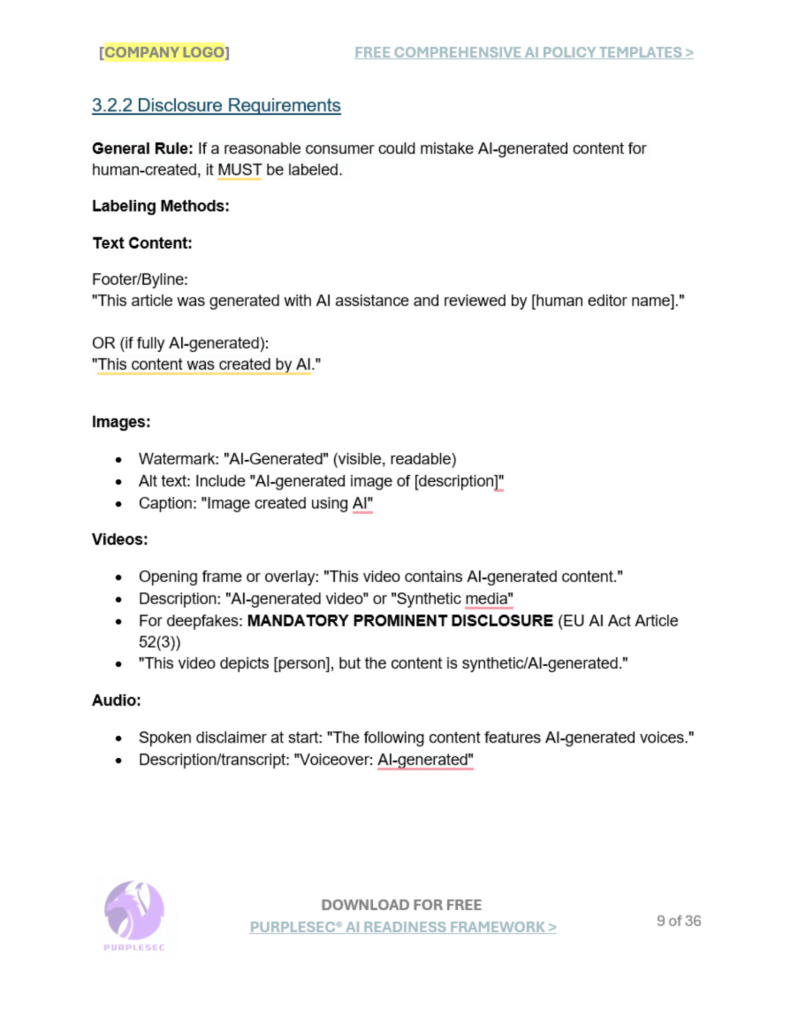
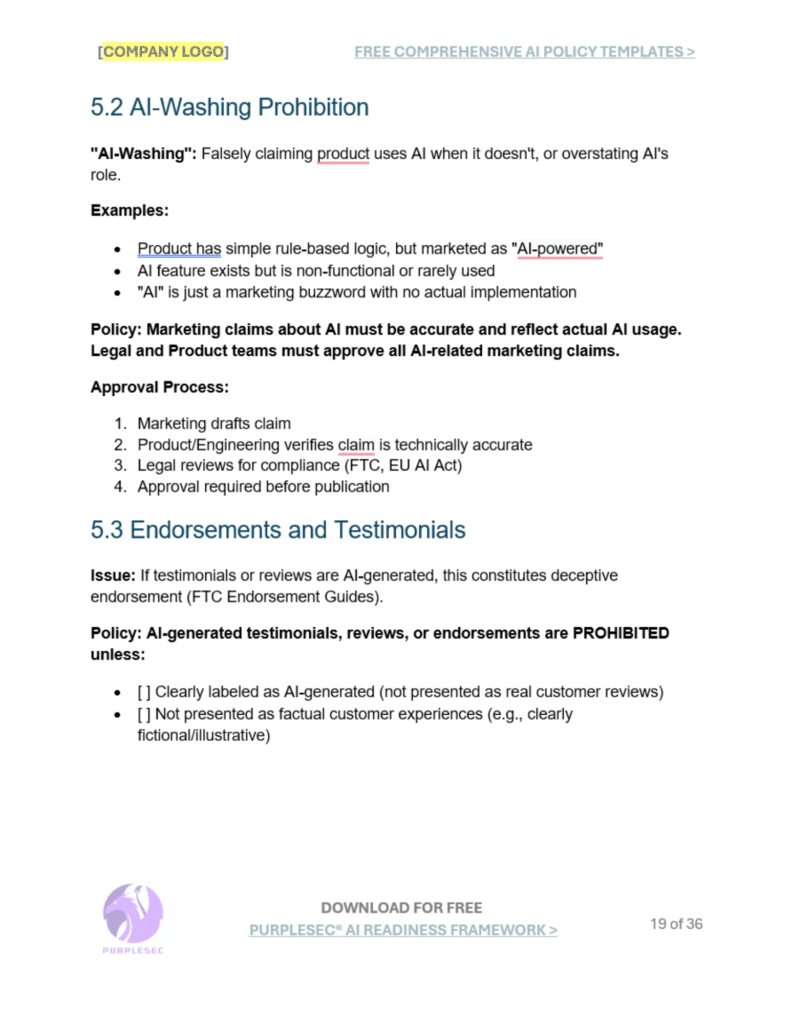

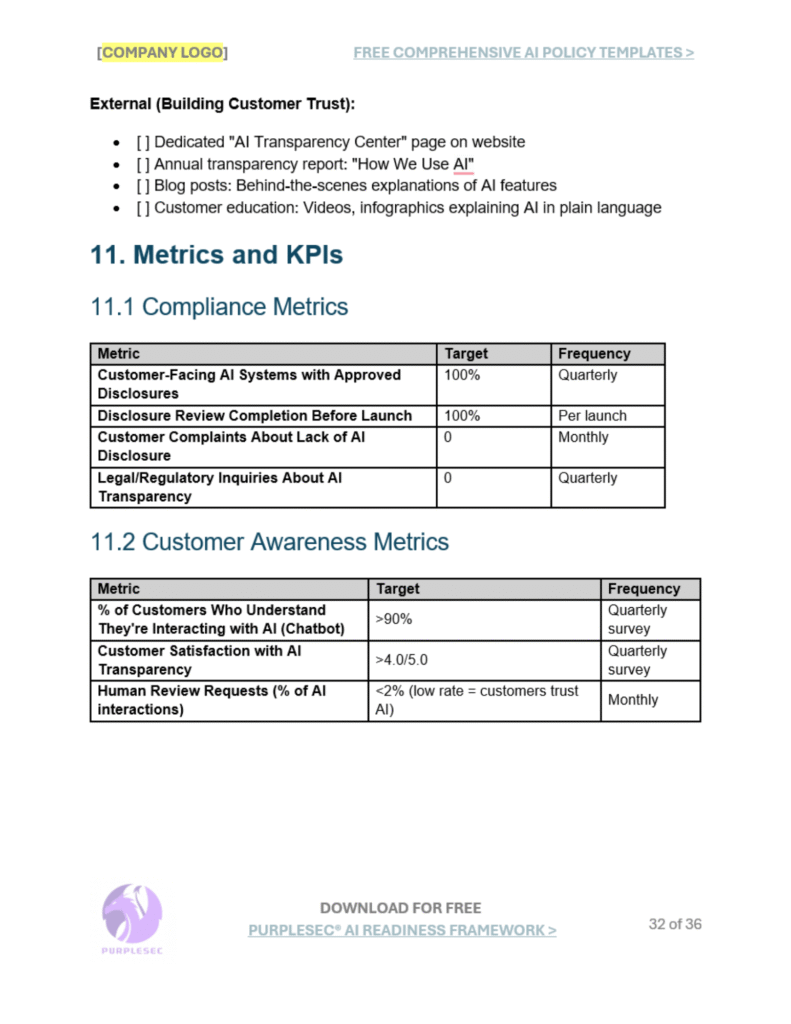

AI Disclosure Policy Template Highlights:
- Chatbot disclosure templates in Word and PDF formats covering opening messages, voice disclaimers, visual indicators (bot icon, persistent badge), escalation trigger words, and prohibited practices.
- AI-generated content labeling for text (byline disclosure), images (watermark plus alt text), video (opening frame overlay, C2PA metadata), audio (spoken disclaimer), with placement near content above the fold.
- Automated decision-making disclosure implementing GDPR Articles 13-14 in privacy policies, point-of-decision notifications for credit/insurance/pricing, human review procedures, and Right to Contest workflows.
- Deepfake and synthetic media requirements per EU AI Act Article 52(3) mandating C2PA machine-readable metadata, prominent human-readable disclosure, consent for likeness, and prohibited uses.
- FTC truthful advertising compliance prohibiting exaggerated AI capability claims, requiring substantiation for benefits, avoiding risk minimization, and preventing deceptive AI-generated endorsements.
- Disclosure placement and prominence implementing “at or before point of interaction” rule, WCAG AA contrast, 10-12pt minimum font, 8th-grade reading level, visual emphasis, and multi-platform consistency.
- Customer rights implementation enabling Right to Human Review within 5 minutes, Right to Explanation providing AI logic details, Right to Contest, opt-out mechanisms for personalization, and 30-day response timeline.
- Pre-launch approval workflow requiring Legal review, Privacy Office GDPR validation, Marketing copy approval, Engineering UI confirmation, and AI Governance Committee sign-off.
- Regulatory compliance mapping to EU AI Act Article 52, FTC Section 5, GDPR Article 22, state laws (California AB 2013, NYC Local Law 144), and China Deep Synthesis Regulations.
Comprehensive AI Security Policies
Start applying our free customizable policy templates today and secure AI with confidence.
Frequently Asked Questions
What Is Included In This Customer-Facing AI Disclosure Policy Template?
This policy includes compliance documentation covering chatbot disclosure requirements, AI-generated content labeling, automated decision transparency, and customer rights implementation with FTC and EU AI Act alignment.
Rather than ambiguous transparency, you get the operational blueprint:
- Chatbot disclosure templates with opening messages and escalation triggers.
- AI content labeling methods for text/images/video/audio with C2PA metadata standards.
- Automated decision-making notifications for credit/insurance/pricing with human review procedures.
- Disclosure placement guidelines meeting WCAG AA contrast and prominence requirements.
The complete framework spans deepfake disclosure with synthetic media warnings, FTC advertising compliance preventing exaggerated claims, customer rights workflows (review, explanation, contest, opt-out), and pre-launch approval checklists.
Why Does My Organization Need AI Disclosure And Transparency Policy?
Here’s what happening in enterprise deployments: organizations deploy customer service chatbots without upfront AI disclosure then face regulatory inquiries. Marketing teams publish AI-generated product images without labeling creating consumer deception. Credit scoring systems deny applications using automated decisions without explanation violating GDPR Article 22. Deepfake videos lack synthetic media warnings triggering platform removal and legal liability.
Regulatory consequences?
- EU AI Act Article 52 mandates chatbot and AI content disclosure with fines up to €15M or 3% global turnover for transparency violations.
- FTC Section 5 prohibits deceptive practices with precedent fines exceeding $5M for misleading AI claims.
- GDPR Article 22 requires automated decision-making explanations with penalties reaching €20M (4% global revenue).
- California AB 2013 and NYC Local Law 144 impose state-specific disclosure requirements with per-violation penalties.
Structured transparency governance prevents deception through upfront chatbot disclosure, enables informed consent with clear AI content labeling, and protects customer rights through human review procedures. You transform “customers don’t know they’re interacting with AI” into compliant disclosure frameworks with documented placement and prominence.
Who Vetted PurpleSec's AI Disclosure And Transparency Policy Template?
Development of this framework was led by Tom Vazdar (Chief AI Officer) and Joshua Selvidge (CTO). They incorporated EU AI Act Article 52 disclosure requirements and FTC advertising standards validated across customer-facing AI deployments.
The policy underwent:
- Legal review for FTC Section 5 deceptive practice compliance and state AI law requirements.
- Privacy Office review for GDPR Article 22 automated decision-making transparency, Marketing review for customer communication feasibility and brand voice consistency.
- UX Design review for WCAG accessibility and visual prominence standards.
What Are The Essential Components Of An AI Disclosure Policy Template?
The essential components of an effective AI Disclosure Policy include:
- Disclosure requirements per use case.
- Placement and prominence standards.
- Customer rights procedures.
- Pre-launch approval workflows.
The template starts with disclosure requirement classification defining when transparency is mandatory versus optional. Then you deploy the framework across policy areas:
- Use Case Disclosure Matrix: Chatbots require upfront disclosure before substantive exchange with persistent visual indicators and human escalation options. AI-generated content needs labeling based on reasonable consumer confusion standard (text bylines, image watermarks, video overlays, audio disclaimers). Automated decision-making demands privacy policy disclosure plus point-of-decision notifications for credit, insurance, pricing, or content moderation. AI-assisted human interactions require disclosure when AI significantly influences customer-facing outputs. Personalization and targeting need privacy policy disclosure with opt-out mechanisms.
Placement and Prominence Standards: “At or before point of interaction” timing rule prevents retroactive disclosure. WCAG AA accessibility compliance (4.5:1 contrast ratio, 10-12pt font minimum). Plain language at 8th-grade reading level avoiding jargon. Visual emphasis for critical disclosures using bold, icons, or borders. Multi-platform consistency across web, mobile, email, social media, in-store, and print. - Customer Rights Procedures: Right to Human Review enabling escalation within 5 minutes during business hours using trigger words or buttons. Right to Explanation providing meaningful AI logic information within 30 days without disclosing trade secrets. Right to Contest allowing appeal of automated decisions with independent review. Opt-out mechanisms for personalization affecting recommendations, ads, or pricing.
- Pre-Launch Approval Workflow: Legal review validates disclosure language and regulatory compliance. Privacy Office confirms GDPR Article 22 and automated decision-making transparency. Marketing approves customer-facing copy for brand consistency. Engineering verifies UI placement and accessibility. AI Governance Committee provides final sign-off before deployment.
The complete policy implementation takes 2-3 weeks for initial deployment with quarterly reviews updating templates based on regulatory changes (new state AI laws, FTC guidance updates) and customer feedback metrics
How Does This AI Disclosure Policy Address GDPR Compliance?
GDPR Articles 13 and 14 require controllers inform data subjects when collecting personal data including existence of automated decision-making. Article 22 grants right not to be subject to solely automated decisions. The policy implements disclosure and rights procedures satisfying these obligations.
The policy supports compliance through:
- Transparency obligations per Articles 13 and 14 (privacy policy discloses AI usage in processing personal data, explanation of automated decision-making logic, categories of data analyzed, consequences of processing, retention periods)
- Automated decision-making disclosure per Article 22(1) (data subjects informed of solely automated decisions producing legal or similarly significant effects, meaningful information about logic provided, significance and envisaged consequences explained)
- Right to human intervention per Article 22(3) (human-in-the-loop for high-impact automated decisions, right to obtain human review of AI recommendation, right to express point of view and contest decision)
- Right to explanation per Recital 71 (simple and meaningful information about logic involved in automated processing, data subject receives explanation within 30 days of request, explanation balances transparency with trade secret protection)
- Consent for special categories per Article 9 (explicit consent obtained before processing special category data in AI systems, consent withdrawal mechanism provided, processing stops when consent withdrawn)
Enterprises processing EU personal data in customer-facing AI must implement privacy policy disclosures, point-of-decision notifications for automated decisions, human review request procedures, explanation workflows within 30-day timeline, and opt-out mechanisms for personalization.
Violations result in penalties reaching €20M (4% of global revenue) for automated decision-making or transparency failures under Article 83.
How Does This AI Disclosure Policy Support EU AI Act Compliance?
EU AI Act Article 52 establishes transparency obligations for AI systems interacting with natural persons. Article 50 requires general-purpose AI providers disclose training content. The policy provides disclosure templates and workflows proving compliance when regulators inspect.
The policy supports regulatory adherence through:
- Chatbot disclosure per Article 52(1) (users informed they’re interacting with AI system before substantive exchange, persistent visual indicators preventing confusion, escalation to human agents with clear procedures, exception when obvious from circumstances like explicit “AI Assistant” invocation).
- AI-generated content labeling per Article 52(2) (content resembling human-created must be labeled as artificially generated, placement near content above the fold, watermarks for images, bylines for text, overlays for video).
- Deepfake disclosure per Article 52(3) (machine-readable metadata using C2PA cryptographic standard, prominent human-readable disclosure warning synthetic nature, consent for likeness usage, prohibition on deceptive deepfakes).
- Training content transparency per Article 50 (general-purpose AI providers publish detailed summary about training content, copyright status disclosure, accessibility to regulators and affected parties).
- Automated decision transparency per Article 13 (existence of automated processing disclosed, meaningful information about logic provided, significance and consequences explained, human oversight demonstrated).
Companies deploying customer-facing AI systems must demonstrate transparency compliance before August 2026 enforcement deadlines through documented disclosure templates, placement meeting prominence requirements, customer rights implementation (review, explanation, contest), and multi-platform consistency.
Non-compliance triggers penalties reaching €15M (3% of global turnover) for transparency violations under Article 99.
What FTC Advertising Compliance Requirements Apply?
FTC Section 5 prohibits unfair or deceptive acts or practices in commerce. FTC’s February 2024 guidance specifically addresses AI marketing claims requiring truthfulness, substantiation, and avoidance of misleading representations about AI capabilities.
- Truthful and substantiated claims requirement: Advertising claims must be truthful and not misleading to reasonable consumers. Claims about AI capabilities require competent and reliable scientific evidence as substantiation. Don’t exaggerate what AI can do (claiming “AI eliminates all customer service wait times” when system handles only 60% of queries). Don’t minimize risks (omitting AI hallucination likelihood when promoting chatbot accuracy). Ensure AI actually delivers advertised benefits (verify performance claims through testing).
- Prohibited deceptive AI claims: Creating fake AI-generated customer testimonials or reviews without disclosure. Using AI to generate misleading endorsements from nonexistent persons. Claiming human review when decisions are solely automated. Advertising “human customer service” when actually AI chatbot. Misrepresenting AI sophistication (claiming general AI when using simple rules-based system).
- Acceptable vs unacceptable claim examples: Acceptable includes “Our AI chatbot can answer common questions 24/7” (specific, provable), “AI-powered recommendations based on your purchase history” (describes actual functionality). Unacceptable includes “Our AI is just like talking to a human expert” (misleading comparison exaggerating capabilities), “AI eliminates 100% of bias” (unsubstantiable absolute claim), “Guaranteed perfect AI predictions” (exaggerates accuracy, impossible standard).
- Disclosure requirements for AI involvement: If AI generates content appearing to be human-created (testimonials, reviews, social media posts), disclosure required preventing consumer deception. If using AI to create fake personas for marketing, disclosure mandatory with FTC guidance treating as deceptive practice. If AI assists human-created content (suggestions, editing), disclosure best practice though not always legally required.
- Companies must substantiate AI marketing claims through performance testing, avoid absolute claims (“100% accurate”), provide disclosure when AI creates human-seeming content, and monitor AI outputs preventing deceptive representations.
FTC enforcement precedent shows fines exceeding $5M for deceptive AI practices.

Build A Functional AI Security Roadmap
Move from high-level planning to hands-on execution with a framework that turns abstract AI risks into actionable operational tasks for your team.
Related AI Security Policy Templates

Go beyond filters or rule-based protections – enter into intelligent AI security that knows and learns.

Proactively learns from every attempted attack ensuring your defenses are always up to date.

Breaches happen across a variety of LLMs/AI tools but PromptShield™ sees through the noise to catch it all.

Inventing novel simulations, PromptShield™ attacks itself to stay ahead of emerging threats.

Inventing novel simulations, PromptShield™ attacks itself to stay ahead of emerging threats.

Put everyone at ease with clear, automated assessments that outline each intercept for total transparency.

Seamless set-up allows the organization AI access without hindering operations or development velocity.

Seamless set-up allows the organization AI access without hindering operations or development velocity.

Seamless set-up allows the organization AI access without hindering operations or development velocity.

Seamless set-up allows the organization AI access without hindering operations or development velocity.

Seamless set-up allows the organization AI access without hindering operations or development velocity.

Seamless set-up allows the organization AI access without hindering operations or development velocity.

Seamless set-up allows the organization AI access without hindering operations or development velocity.