AI Red Teaming Implementation Checklist
An AI Red Teaming Implementation Checklist is a customizable operational document that establishes adversarial testing procedures for LLM systems, classifying attack scenarios, defining success metrics, and requiring vulnerability remediation before production deployment. This checklist transforms ad-hoc security testing into structured cognitive exploit validation while preventing prompt injection bypasses, jailbreak vulnerabilities, and guardrail evasion patterns.

Get your complete AI security policy package:
Home » Resources » AI Security Policy Templates » AI Red Teaming Implementation Checklist
AI Risks Your AI Red Teaming Checklist Must Address
Test cognitive exploits systematically, measure Attack Success Rate, validate guardrail effectiveness, and build incident response muscle memory.
Test OWASP LLM top 10 systematically
by executing prompt injection, jailbreaking, data exfiltration, goal hijacking, and bias elicitation attacks with automated tools (Garak, PyRIT) and manual testing across all categories.
Measure attack success rate baselines
by tracking percentage of attacks bypassing guardrails (target <1%), Mean Time to Detect (target <15 min), False Positive Rate (target <2%), and remediation completion within SLAs.
Validate guardrail effectiveness
by testing input filters with obfuscation techniques, output DLP with extraction prompts, multi-turn conversation exploits, and indirect injection via external content with documented bypass methods.
Build organizational incident response capacity
by simulating data exfiltration scenarios, goal hijacking sequences, bias manifestation cases, and supply chain compromises with post-engagement lessons learned and updated runbooks.



AI Red Teaming Checklist Template Highlights:
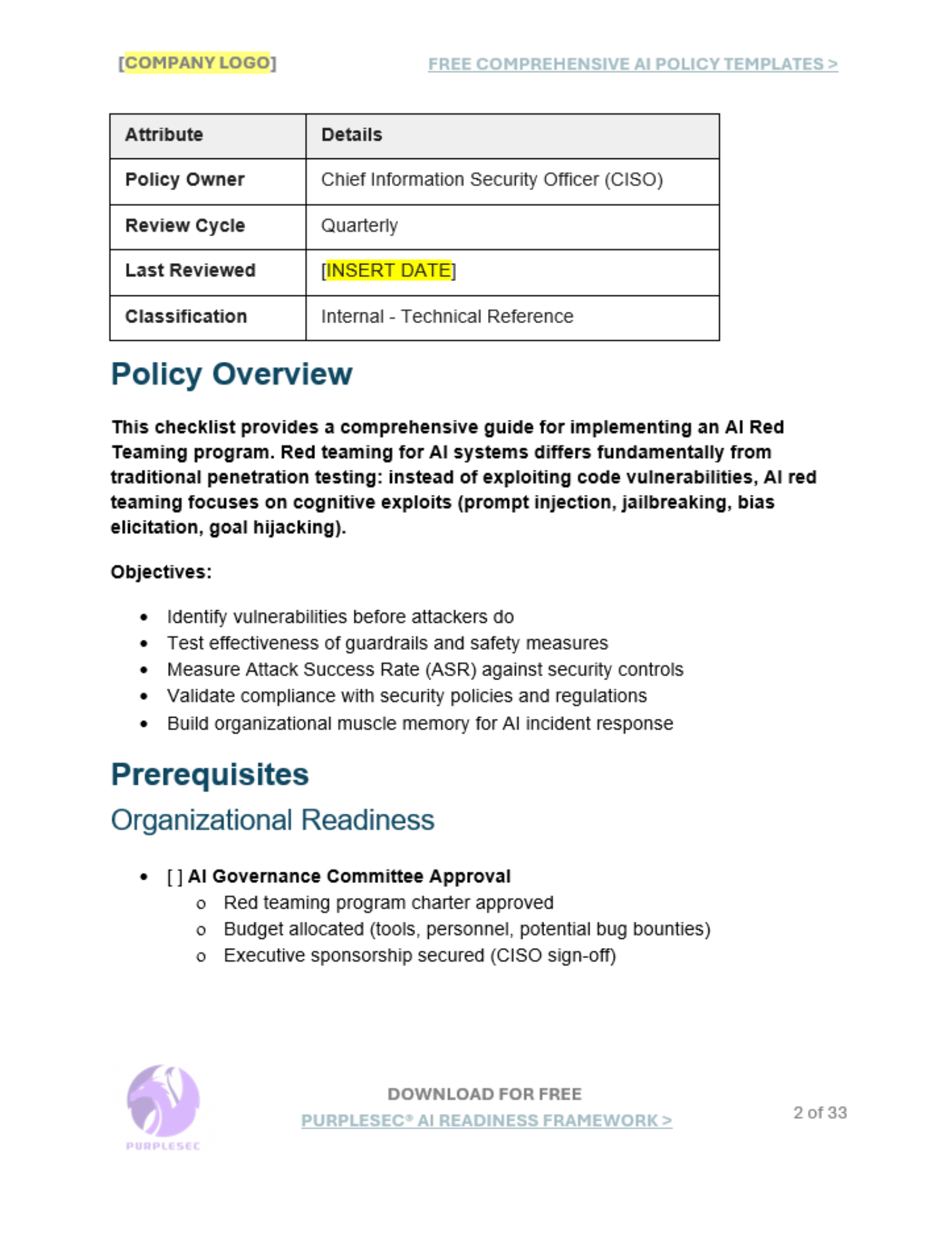
- 4-phase engagement structure in Word and PDF formats covering Planning and Scoping, Reconnaissance and Threat Modeling, Attack Execution, and Reporting with success criteria and approval workflows.
- OWASP LLM Top 10 attack scenarios including prompt injection (direct and indirect), insecure output handling, training data poisoning, model denial of service, supply chain vulnerabilities, sensitive information disclosure, insecure plugin design, excessive agency, overreliance, and model theft.
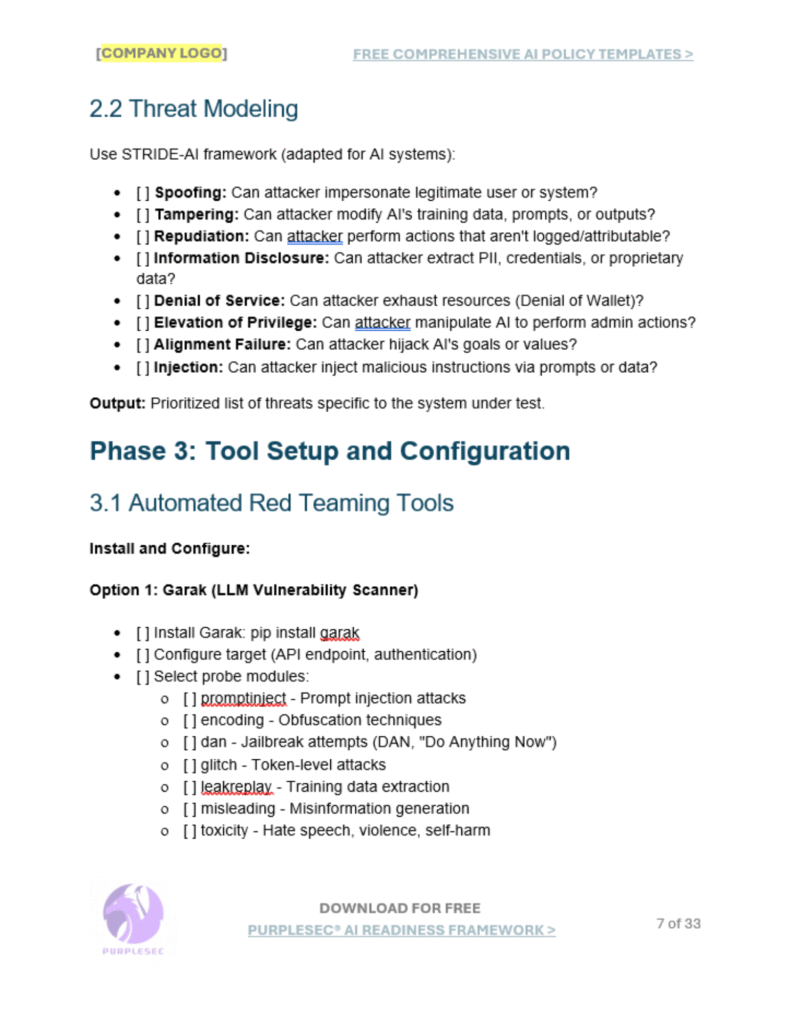
- Automated testing tools integration supporting Garak vulnerability scanner, Microsoft PyRIT for multi-turn attacks, NVIDIA NeMo Guardrails testing framework, and custom Python scripts.
- Attack Success Rate measurement tracking percentage of successful bypasses (target <1%), critical findings count (target 0 for production), Mean Time to Detect (target <15 min), and False Positive Rate (target <2%).
- Prompt injection test matrix covering instruction override, role-playing, delimiter confusion, payload splitting, obfuscation (Base64, ROT13, leetspeak), and multi-turn conversation exploits.
- Data exfiltration scenarios testing system prompt extraction, training data extraction, credential leakage, PII in outputs through model memorization, and RAG knowledge base poisoning.
- Jailbreak testing procedures including DAN mode variations, hypothetical scenarios, creative writing bypasses, educational purpose framing, and GCG-optimized suffix attacks.
- Bias elicitation framework measuring discriminatory outputs for protected attributes, testing hiring/credit decision bias, validating fairness constraints, and documenting disparate impact patterns.
- Continuous testing cycles with quarterly engagement schedules, threat intelligence monitoring, toolkit updates, bug bounty integration, and annual coverage of all production AI systems.
Comprehensive AI Security Policies
Start applying our free customizable policy templates today and secure AI with confidence.
Frequently Asked Questions
What Is Included In This AI Red Teaming Implementation Checklist Template?
This playbook is a comprehensive adversarial testing guide defining planning procedures, attack scenarios, success metrics, and reporting requirements for LLM security validation. It’s a ready-to-deploy checklist covering OWASP LLM Top 10, automated testing tools, and continuous testing cycles.
Instead of improvising security tests, we’ve mapped out the attack execution framework:
- Prompt injection variations.
- Jailbreak bypasses.
- Data exfiltration techniques.
- Goal hijacking scenarios.
- Bias elicitation methods.
You get the complete program across red team composition, tool setup (Garak, PyRIT, custom scripts), Attack Success Rate measurement, and remediation workflows.
Why Does My Organization Need AI Red Teaming Checklist?
Here’s what we’re seeing in production: organizations deploy guardrails but never test them adversarially. A simple “ignore previous instructions” prompt bypasses the entire security stack. An attacker uses Base64 encoding to exfiltrate system prompts containing proprietary IP. A jailbreak discovered on Reddit works against the production chatbot because nobody tested DAN mode variations.
The regulatory exposure? EU AI Act requires demonstrating security testing for high-risk systems before deployment. Untested guardrails create false confidence leading to production incidents that trigger GDPR breach notification and regulatory scrutiny. Bug bounty researchers finding basic prompt injection vulnerabilities damages reputation.
Structured red teaming validates security controls work under adversarial conditions. The checklist defines what to test (OWASP LLM Top 10), how to measure success (Attack Success Rate <1%), and when to remediate (before production deployment). You transform “we have guardrails” into “we’ve tested guardrails against 1000+ attack variations and documented bypass methods.”
Who Vetted PurpleSec's AI Red Teaming Checklist Template?
We built this checklist with Tom Vazdar (Chief AI Officer) and Joshua Selvidge (CTO) leading the testing methodology. They incorporated OWASP LLM Top 10 attack patterns and NIST AI RMF validation guidance tested across enterprise AI deployments.
The checklist underwent validation through:
- Active red team engagemente.
- SOC team review for detection capability assessment.
- Legal review for safe harbor provisions protecting red teamers.
We mapped every attack scenario to specific OWASP categories and created success metrics based on industry benchmarks for Attack Success Rate, Mean Time to Detect, and remediation completion.
What Are The Essential Components Of A AI Red Teaming Checklist?
Three requirements matter most when developing an AI Red Teaming Checklist:
- What attacks you execute.
- How you measure success.
- When you remediate findings.
Implementation starts with program setup through AI Governance Committee approval, legal review for testing boundaries, red team composition (lead plus 2-3 specialists), and tool provisioning.
Then you deploy the testing framework across four phases:
- Planning and Scoping: Define systems under test prioritizing High-Risk AI, establish Rules of Engagement (testing hours, notification protocol, stop conditions), set success metrics (ASR <1%, MTTD <15 min), and obtain approval.
- Reconnaissance and Threat Modeling: Review system documentation, analyze guardrail architecture, map AI integrations (email, Slack, databases, APIs), identify permissions, and apply STRIDE-AI framework.
- Attack Execution: Run automated baseline scans with Garak or PyRIT (1000+ prompts), execute manual OWASP LLM Top 10 testing, attempt prompt injection with 20+ variations, test jailbreaks with DAN mode and hypothetical scenarios, try data exfiltration with 50+ extraction prompts.
- Reporting: Document findings with Proof of Concept demonstrations, assign severity (P1-P4), calculate Attack Success Rate, present to stakeholders, create remediation tickets, and schedule verification testing.
The full program implementation takes 4-6 weeks for initial engagement with quarterly testing cycles for continuous validation.
How Does This Checklist Support EU AI Act Compliance?
The EU AI Act requires demonstrating security testing and validation for high-risk AI systems before deployment. Red teaming provides the technical evidence needed to prove due diligence.
The checklist supports compliance through documented testing methodology covering all major threat categories (OWASP LLM Top 10), measurable security metrics (Attack Success Rate, Mean Time to Detect), remediation verification confirming fixes prevent recurrence, and audit trails maintaining test plans, findings reports, and remediation records.
- Article 15 requirements: The EU AI Act mandates “accuracy, robustness and cybersecurity” for high-risk systems. Red teaming validates robustness against adversarial inputs, cybersecurity through penetration testing of AI-specific attack vectors, and accuracy by testing hallucination detection and bias mitigation.
- Documentation for regulators: When authorities request evidence of security validation, organizations produce red team reports showing comprehensive testing (1000+ attack attempts), quantified security posture (ASR <1%), documented vulnerabilities with remediation, and verification testing confirming fixes.
Organizations deploying before enforcement deadlines (August 2026 for high-risk systems) avoid sanctions reaching €35M or 7% of global revenue by demonstrating structured adversarial testing validated through quarterly engagements with documented Attack Success Rate improvements.
What Is Attack Success Rate And Why Does It Matter?
Attack Success Rate measures the percentage of adversarial prompts that successfully bypass guardrails and achieve attacker objectives. It’s the primary metric for AI security posture. Target ASR is <1% for production systems meaning fewer than 1 in 100 attacks succeed.
- Calculation: ASR = (Successful Attacks / Total Attack Attempts) × 100. If you test 1000 prompt injection variations and 15 bypass guardrails, your ASR is 1.5% which exceeds the target indicating guardrail weaknesses.
- Why it matters: Traditional security metrics like vulnerability counts don’t capture AI-specific risks. You might have zero CVEs but 50% ASR if guardrails are ineffective. ASR quantifies actual adversarial robustness rather than theoretical security controls.
- Benchmark targets: Production systems should achieve <1% ASR. Systems in development can tolerate 5-10% ASR during iterative improvement. Newly deployed systems often start at 20-30% ASR before hardening through red team feedback.
The checklist tracks ASR per engagement, trending over time to validate security improvements. Remediation focuses on high-frequency bypass techniques that inflate ASR rather than obscure edge cases.
What Tools Does The Checklist Cover For Automated Testing?
The checklist integrates four primary automated testing frameworks plus custom scripting options. Each tool serves different attack scenarios with varying automation levels.
- Garak (LLM Vulnerability Scanner): Runs comprehensive probe modules including promptinject, encoding obfuscation, DAN jailbreaks, glitch token-level attacks, leakreplay training data extraction, misleading misinformation generation, and toxicity hate speech testing. Installation via pip, targets multiple LLM APIs (OpenAI, Anthropic, local models), baseline scan executes 1000+ prompts automatically.
- Microsoft PyRIT (Python Risk Identification Toolkit): Specializes in multi-turn conversation attacks where payloads split across messages, includes built-in jailbreak prompt datasets, exports results for analysis, targets conversational AI and chatbots.
- NVIDIA NeMo Guardrails Testing Framework: Built specifically for systems using NeMo Guardrails, creates adversarial test cases, measures guardrail effectiveness with detailed metrics, validates rule configurations.
- Custom Python Scripts: Developed for batch testing iterating through attack prompts, multi-turn attacks maintaining stateful conversations, parameter fuzzing injecting special characters and extreme values, API interception using Burp Suite or Postman.
The checklist recommends starting with automated baseline scans to identify low-hanging fruit, then progressing to manual testing for sophisticated attacks requiring human creativity and context understanding.
How Do You Measure Red Team Program Maturity?
Program maturity tracking ensures continuous improvement rather than one-time testing. The checklist defines metrics across engagement success, detection capability, and organizational coverage.
- Engagement metrics: Coverage achieving 100% OWASP LLM Top 10 categories tested, findings generating at least 5 actionable vulnerabilities indicating thorough testing, remediation completing 100% of P1/P2 findings within SLA, and verification confirming 100% of fixes with no regressions.
- Detection metrics: Mean Time to Detect averaging <15 minutes for obvious attacks, False Positive Rate staying <2% preventing legitimate user friction, and alert quality ensuring security team can triage effectively.
- Program coverage: Red team testing covering 100% of production AI systems annually, external researcher engagement through bug bounty generating 10+ valid submissions per year if program active, and quarterly testing cycles maintaining continuous validation.
- Maturity progression: Level 1 (Ad-hoc) conducts testing before major releases only. Level 2 (Managed) performs quarterly engagements with documented procedures. Level 3 (Optimized) integrates continuous testing with automated regression testing and active bug bounty program.
The checklist includes reporting templates tracking these metrics over time showing trend lines for Attack Success Rate reduction, Mean Time to Detect improvement, and coverage expansion across AI portfolio.

Build A Functional AI Security Roadmap
Move from high-level planning to hands-on execution with a framework that turns abstract AI risks into actionable operational tasks for your team.
Related AI Security Policy Templates

Go beyond filters or rule-based protections – enter into intelligent AI security that knows and learns.

Proactively learns from every attempted attack ensuring your defenses are always up to date.

Breaches happen across a variety of LLMs/AI tools but PromptShield™ sees through the noise to catch it all.

Inventing novel simulations, PromptShield™ attacks itself to stay ahead of emerging threats.

Inventing novel simulations, PromptShield™ attacks itself to stay ahead of emerging threats.

Put everyone at ease with clear, automated assessments that outline each intercept for total transparency.

Seamless set-up allows the organization AI access without hindering operations or development velocity.

Seamless set-up allows the organization AI access without hindering operations or development velocity.

Seamless set-up allows the organization AI access without hindering operations or development velocity.

Seamless set-up allows the organization AI access without hindering operations or development velocity.

Seamless set-up allows the organization AI access without hindering operations or development velocity.

Seamless set-up allows the organization AI access without hindering operations or development velocity.

Seamless set-up allows the organization AI access without hindering operations or development velocity.
Get Secure With PromptShield™
Fortify for the future with the only intent-based Prompt WAF on the market.