
AI Detection & Monitoring
AI detection and monitoring in cybersecurity treats semantic analysis, behavioral baselining, and drift detection as engineering requirements with measurable controls. Closing that gap requires controls that operate at the inference layer, where attacks arrive as natural language and models degrade silently, not at the signature layer where legacy tools are watching.
- Last Updated: April 21, 2026
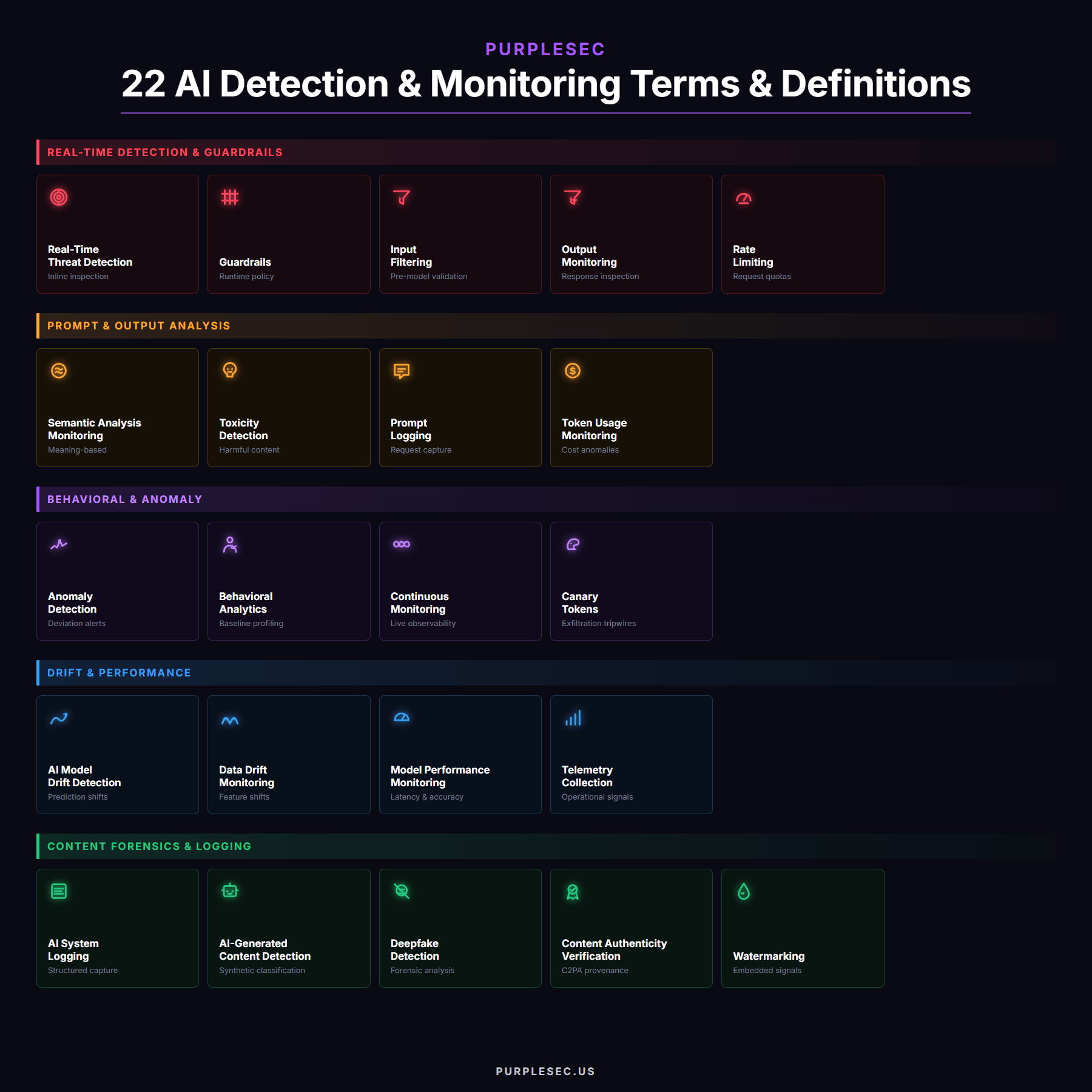
AI Detection & Monitoring Terms & Definitions
This page defines 22 controls, techniques, and artifacts that let security teams see what AI systems actually do at runtime. Each risk is mapped to our AI Readiness Framework and the PromptShield™ Risk Management Framework so detection activity connects to a specific signal, not a dashboard that nobody reads.
AI-Generated Content Detection
The classification of text, image, audio, or video as AI-generated versus human-created, used to flag synthetic content at ingestion and preserve downstream content integrity.
AI Model Drift Detection
The monitoring of prediction distributions, feature distributions, and model accuracy over time to catch data drift, concept drift, and prediction drift before business impact surfaces.
AI System Logging
The structured capture of prompts, responses, tool calls, decisions, and model metadata with retention periods aligned to compliance requirements, typically 12 months minimum.
Anomaly Detection
The statistical or ML-based identification of prompts, outputs, or behaviors that deviate from documented baselines, flagging activity that warrants human review.
Behavioral Analytics
The continuous profiling of AI system behavior across users, sessions, and workflows to establish baselines and detect deviations that indicate compromise, misuse, or drift.
Canary Tokens
Synthetic identifiers embedded in training data, system prompts, or retrieval sources that trigger alerts if they appear in model outputs, proving exfiltration or memorization after the fact.
Content Authenticity Verification
The validation of content origin using standards like C2PA to confirm whether media was captured by a specific device, edited, or generated by AI.
Continuous Monitoring
The ongoing collection and analysis of AI system telemetry across security, performance, fairness, and drift dimensions, replacing point-in-time audits with live observability.
Data Drift Monitoring
The detection of shifts in input feature distributions over time using statistical tests like Kolmogorov-Smirnov and Chi-square, with tools like Evidently AI and Alibi Detect.
Deepfake Detection
The classification of audio, video, or images as authentic or AI-manipulated using forensic artifacts, biometric inconsistencies, or cryptographic content credentials at ingress.
Guardrails
Runtime controls that enforce policy on AI inputs and outputs, blocking prompt injection, PII leakage, toxic content, and tool misuse before they reach users or downstream systems.
Input Filtering
The preprocessing layer that validates, sanitizes, and scores prompts for injection attempts, policy violations, and oversized payloads before they reach the model.
Model Performance Monitoring
The tracking of latency, throughput, accuracy, and error rates for deployed models, with tiered alerts when metrics breach documented thresholds.
Output Monitoring
The post-inference inspection of model responses for PII leakage, system prompt extraction, toxic content, hallucinations, and policy violations before they reach users.
Prompt Logging
The structured capture of every prompt submitted to an AI system along with its response, user context, and blocked-request metadata, retained for forensics and compliance.
Rate Limiting
The enforcement of per-user and per-API-key request quotas that prevent denial-of-wallet attacks, limit model inversion attack volume, and contain the blast radius of compromised credentials.
Real-Time Threat Detection
The inline inspection of AI interactions as they occur, classifying intent and blocking malicious traffic before the model processes it rather than logging after the fact.
Semantic Analysis Monitoring
The classification of prompt and response meaning rather than surface patterns, catching adversarial intent that signature-based detection misses because attackers use ordinary language.
Telemetry Collection
The gathering of operational signals from AI systems including latency, cost, request volume, drift scores, and guardrail block rates, feeding dashboards and SIEM correlation.
Token Usage Monitoring
The tracking of prompt and completion token consumption by user, endpoint, and time window, used to detect cost anomalies that indicate denial-of-wallet attacks or runaway automation.
Toxicity Detection
The classification of prompts or outputs as containing harmful, abusive, or policy-violating language, with tiered response ranging from logging to inline blocking.
Watermarking
The embedding of detectable signals into AI-generated content that identifies its origin and survives common transformations, used for provenance tracking and deepfake mitigation.

A Practical Framework For Secure, Responsible AI
AI security is not a one-time deployment. It is an ongoing discipline. PurpleSec emphasizes structured discovery, contextual risk analysis, practical control implementation, and continuous refinement.
Frequently Asked Questions
How Is AI Detection & Monitoring Different From Traditional SIEM?
Traditional SIEM correlates packet patterns, log signatures, and known IOCs. AI attacks break that model because the payload is natural language, not code. There is no hash to match, no packet signature to fingerprint, and no predictable request sequence to filter. A malicious prompt can look identical to a legitimate one until you evaluate its intent.
AI detection adds three capabilities legacy SIEM lacks:
- Semantic classification of prompt purpose.
- Behavioral baselining of model output patterns.
- Drift detection of model predictions over time.
Feed the AI signals into the existing SIEM for correlation, but do not expect signature-based SIEM alone to catch attacks that use ordinary language as the weapon.
How Do These Controls Map To NIST AI RMF, The EU AI Act, And ISO 42001?
Three regimes drive AI monitoring obligations:
- The NIST AI RMF MEASURE function requires continuous measurement of AI system risks, with MEASURE 2 subcategories covering trustworthiness characteristics including validity, reliability, and security.
- The EU AI Act Article 16 requires providers of high-risk AI systems to implement post-market monitoring, and Article 72 requires logs to be kept for the duration of the AI system’s lifecycle (minimum six months).
- ISO 42001 Annex A controls A.6.2.6 and A.6.2.7 require continuous monitoring of AI system performance and security.
Treat NIST AI RMF as the measurement taxonomy, the EU AI Act as the post-market monitoring mandate, and ISO 42001 as the operating-system standard that formalizes how monitoring runs day to day.
How Do Detection & Monitoring Failures Turn Into Security Incidents?
Models fail silently. Unlike traditional software that throws errors, a drifting model keeps serving predictions that are increasingly wrong while confidence scores still look normal. An attacker who sends one prompt injection per hour for 24 hours stays below per-minute SIEM thresholds and never triggers a single alert.
A compromised credential running automated prompt loops drains the API budget into five figures before morning because cost anomaly alerting was never configured. System prompts leak because output monitoring was passive. A canary token buried in training data proves exfiltration after the fact, not during. Every one of these is a P1 or P2 incident, and every one started as a gap in the detection stack.
What Detection Gaps Do Most Companies Overlook?
Research shows 32% of organizations experienced prompt injection in the past year, yet only 35% have deployed dedicated AI detection. Most programs log prompts and stop there. The gaps that drive incidents are elsewhere.
- Single-turn detection misses multi-turn adversarial chains that split a malicious objective across harmless-looking messages.
- Correlation windows that reset every minute miss low-and-slow attackers who pace one injection per hour.
- Output monitoring is configured for toxicity but not for system prompt extraction or PII leakage.
- Drift detection watches aggregate accuracy and misses group-specific degradation that quietly breaks fairness.
- Telemetry covers latency and cost but not behavioral baselines, so anomalous agent actions look identical to legitimate ones.
Dashboards exist but nobody tuned the SIEM rules, so alert fatigue buries the real signal.
Do All 22 Detection & Monitoring Terms Apply To Every Organization?
Scope depends on deployment context and model criticality:
- Organizations running SaaS AI tools prioritize prompt logging, output monitoring, guardrails, rate limiting, and token usage monitoring at the API layer.
- Organizations running agentic AI add behavioral analytics, canary tokens, and real-time threat detection to catch autonomous actions outside defined boundaries.
- Organizations training or fine-tuning their own models add AI model drift detection, data drift monitoring, and model performance monitoring across the training and inference pipeline.
- Organizations generating content add watermarking, content authenticity verification, deepfake detection, and AI-generated content detection to protect downstream integrity.
Map each system to its deployment context first, then apply the terms that fit.
Which AI Detection & Monitoring Controls Should We Prioritize First?
Sort controls into three tiers tied to where attacks actually land:
- Tier 1, run now: prompt logging with 12-month retention, SIEM integration with correlation rules for injection bursts (more than 5 blocks from one user in 10 minutes), PII leakage spikes (more than 3 output detections in 1 hour), and cost anomalies (API spend above 200% of daily average). Input filtering and guardrails on every production AI endpoint.
- Tier 2, run next quarter: semantic analysis monitoring for intent classification, behavioral analytics with documented baselines, AI model drift detection using Kolmogorov-Smirnov and Chi-square tests via Evidently AI or Alibi Detect, and tiered drift response (under 5% continue monitoring, 5 to 10% schedule retraining within a month, above 10% rollback or emergency retraining).
- Tier 3, emerging watch list: canary tokens in training data and system prompts, content authenticity verification for generated outputs, deepfake detection at ingress, and watermarking for provenance tracking.
PurpleSec’s AI Readiness Framework maps each tier to concrete milestones by AI maturity.
How Do We Measure Whether AI Detection & Monitoring Is Working?
Five metrics govern whether a detection program is operational:
- Detection rate above 95% across a standardized attack corpus (Garak, PyRIT, OWASP LLM Top 10 scenarios).
- False positive rate below 2% on legitimate traffic. Anything higher drives users around the controls and breaks the program.
- Mean Time to Detect under 15 minutes for high-severity events, measured from attack timestamp to first SIEM alert.
- 100% coverage of production AI endpoints with prompt logging, output monitoring, and SIEM forwarding. No shadow endpoints, no unlogged traffic.
- Quarterly purple-team validation confirming the blue team actually detects what the red team finds. A detection that exists in theory but fails in live exercise does not count.
Trending these five numbers month over month is what separates a detection program from a logging configuration.
Related Glossary Categories
The 21 attack vectors and failure modes spanning prompt injection, data exfiltration, bias, and supply chain compromise, each tied to measurable business impact.
The policies, roles, and accountability structures that determine who controls an AI system’s behavior, deployment decisions, and escalation paths.
Meeting regulatory obligations like the EU AI Act, NIST AI RMF, GDPR, and ISO 42001 before enforcement gaps become audit findings.
Identifying, assessing, and prioritizing AI-specific threats to apply controls proportional to actual business impact.
Validating an AI system’s resilience against prompt injection, jailbreaking, data poisoning, and model manipulation before attackers do.
Ensuring AI systems operate fairly and transparently by closing the gap between what a model can do and what it should.
Protecting personal data throughout the AI lifecycle, from training collection through inference outputs, to prevent unintended exposure.
Securing the third-party models, datasets, and libraries an AI system depends on to prevent hidden backdoors in production.
The structured process for containing, investigating, and recovering from AI security events when preventive controls fail.