AI Compliance In Cybersecurity
AI compliance in cybersecurity covers the regulatory obligations, industry standards, and governance controls that apply specifically to how AI systems process data, make decisions, and manage risk. Traditional compliance programs miss AI-specific requirements like model transparency, algorithmic bias testing, human oversight mandates, and training data provenance.
- Last Updated: April 21, 2026

AI Compliance Terms & Definitions
This page includes terms, definitions, and real-world examples of the AI compliance requirements businesses must address across regulatory frameworks including the EU AI Act, GDPR, HIPAA, NIST AI RMF, PCI-DSS, SOC 2, and ISO 27001. Each term is mapped to our AI Readiness Framework and the PromptShield™ Risk Management Framework to show how compliance obligations translate into operational security controls.
AI Act (EU)
The European Union’s risk-tiered law regulating AI systems, with penalties up to 7% of global revenue for prohibited practices and high-risk violations.
AI Conformity Assessment
The pre-market evaluation process high-risk AI providers must complete to prove their systems meet EU AI Act requirements before deployment.
AI Regulatory Mapping
Cataloging every AI system against the specific laws, frameworks, and sector rules that govern its data, deployment context, and decision outputs.
AI Regulatory Sandbox
A controlled testing environment offered by regulators that lets AI providers trial innovations under supervision without triggering the full compliance load upfront.
AI Standards Catalog
A curated registry of the technical standards like ISO, IEC, and NIST that translate AI regulation into measurable engineering requirements.
Algorithmic Accountability
The legal and operational obligation to assign clear ownership for AI decisions so affected parties can identify who is responsible and seek recourse.
Algorithmic Impact Assessment
A structured evaluation of an AI system’s potential harms to individuals, groups, and society, required before deployment in high-risk use cases across multiple jurisdictions.
Automated Decision-Making Regulations
Laws like GDPR Article 22 that restrict fully automated decisions with legal or similarly significant effects on individuals and mandate human review rights.
Blueprint For An AI Bill Of Rights
The non-binding White House framework outlining five principles for protecting Americans from unsafe, biased, or opaque automated systems.
Colorado AI Act
The first US state AI law of its kind, effective 2026, requiring developers and deployers of high-risk AI to prevent algorithmic discrimination and disclose usage to consumers.
Digital Operational Resilience Act (DORA)
The EU regulation requiring financial sector firms to manage ICT risk, including AI systems, with mandatory incident reporting and third-party oversight.
Executive Order 14110
The 2023 US executive order on Safe, Secure, and Trustworthy AI that directed federal agencies to set standards for AI safety and civil rights, rescinded by Executive Order 14148 in January 2025.
GDPR AI Regulations
The GDPR provisions that apply to AI systems processing personal data, including consent, data minimization, automated decision rights, and erasure of model-encoded data.
High-Risk AI System Classification
The EU AI Act Annex III designation for AI used in employment, credit, law enforcement, healthcare, education, critical infrastructure, and biometric identification that triggers the heaviest compliance load.
HIPAA AI Requirements
The privacy, security, and breach notification rules that govern AI systems processing Protected Health Information in US healthcare settings.
ISO/IEC 23894
The international standard providing AI-specific risk management guidance that translates abstract risk concepts into operational practices for AI development and deployment.
ISO/IEC 42001
The international management system standard for AI that formalizes how organizations operate, monitor, and continuously improve their AI governance day to day.
NIS2 Directive
The EU cybersecurity directive expanding scope to critical sectors and requiring risk management, incident reporting, and supply chain security for AI systems in regulated entities.
NIST AI Risk Management Framework
The voluntary US framework organizing AI trustworthiness controls across four functions (Govern, Map, Measure, Manage) adopted by most organizations as the taxonomy for AI risk programs.
Prohibited AI Practices
The AI applications the EU AI Act bans outright, including social scoring, real-time biometric surveillance in public spaces, and exploitation of vulnerabilities in children or disabled persons.
Right To Explanation
The obligation in GDPR, the EU AI Act, and several US state laws that requires meaningful explanation of AI decisions affecting individuals.
Transparency Obligations
The EU AI Act Article 50 rules requiring disclosure when users interact with AI, when content is AI-generated, and when biometric or emotion recognition is in use.
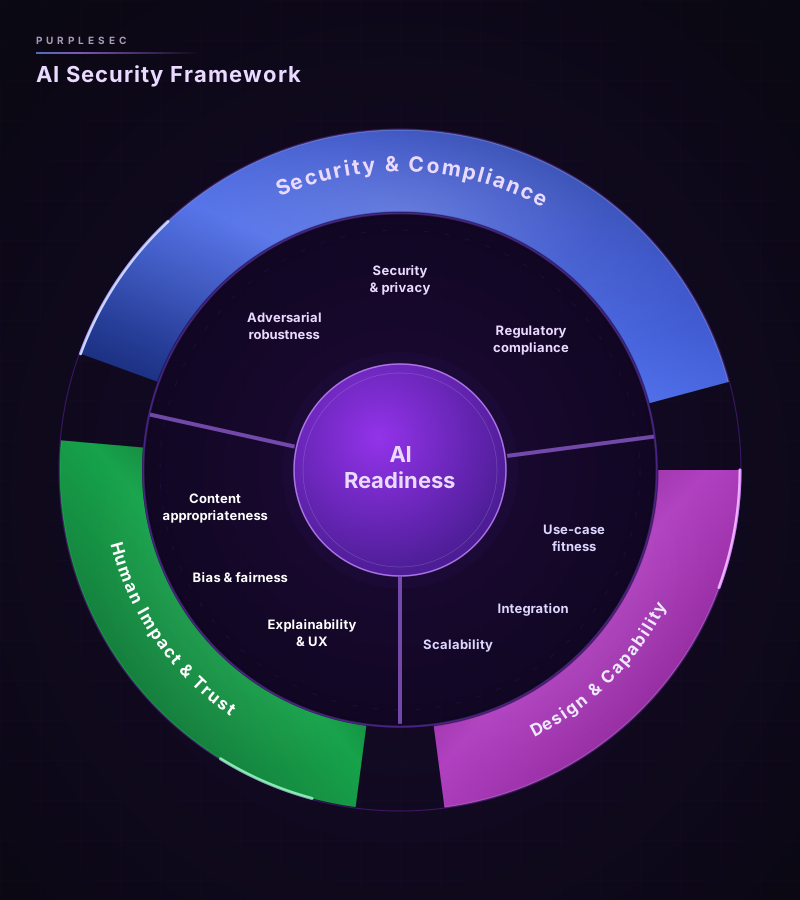
A Practical Framework For Secure, Responsible AI
AI security is not a one-time deployment. It is an ongoing discipline. PurpleSec emphasizes structured discovery, contextual risk analysis, practical control implementation, and continuous refinement.
Frequently Asked Questions
What Is AI Compliance In Cybersecurity?
AI compliance in cybersecurity means meeting the legal, regulatory, and governance requirements that apply specifically to AI systems operating within an organization’s security environment. That includes obligations around data governance, model transparency, bias prevention, incident response, records retention, and human oversight.
Traditional compliance covers infrastructure and data protection. AI compliance adds non-deterministic system behavior, training data provenance, and autonomous decision-making to the scope.
How Is AI Compliance Different From Traditional IT Compliance?
Traditional IT compliance focuses on infrastructure, access controls, and data at rest or in transit. AI compliance adds model behavior, training data integrity, algorithmic fairness, and output quality. AI systems introduce risks with no traditional equivalent: hallucinated outputs, prompt injection, data poisoning, and cross-model inconsistencies.
Compliance programs must also cover the full model lifecycle from data acquisition through deployment monitoring to model retirement, including data unlearning procedures required under GDPR’s right to erasure.
What's The First Step Toward AI Compliance?
Start with a complete AI inventory. Catalog every AI system in use, including unapproved shadow AI tools that employees adopted without IT visibility.
Map each system to applicable regulatory frameworks by architecture, data access, and deployment model. Classify data into four levels from public to restricted, with AI-specific risk assessments at each level. The discovery phase alone typically surfaces shadow AI that creates unmanaged regulatory exposure.
Which Regulations Apply To AI Systems?
AI-specific frameworks include the EU AI Act, NIST AI RMF, OWASP LLM Top 10, and ISO 42001, MIT AI Risk Repository. The EU AI Act classifies AI systems by risk tier and mandates conformity assessments, transparency, and human oversight for high-risk deployments. NIST AI RMF provides structured risk management methodology. OWASP LLM Top 10 identifies the most critical security risks in large language model applications.
Traditional standards like HIPAA, HITRUST, PCI-DSS, SOC 2, and ISO 27001 are also starting to incorporate AI-specific requirements into their frameworks as adoption accelerates.
How Do NIST AI RMF, OWASP, And The EU AI Act Compare?
- NIST AI RMF provides a voluntary governance framework covering risk identification, assessment, and management across the AI lifecycle.
- The EU AI Act is binding law with enforcement penalties, mandatory conformity assessments, and explicit prohibitions on certain AI uses.
- OWASP LLM Top 10 focuses on technical attack vectors specific to large language models, with prompt injection ranked as the top risk for two consecutive years.
- ISO 42001 establishes management system requirements for organizations developing or using AI. NIST and ISO 42001 address governance and process.
How Does AI Compliance Apply To Healthcare And Financial Services?
Healthcare AI compliance spans HIPAA, HITRUST, ISO 27001, SOC 2, and FDA requirements with tiered human-in-the-loop controls. Specific obligations include real-time PHI detection and redaction, output validation for clinical documentation, and audit trails for all AI-assisted decisions.
Financial services AI compliance requires alignment with PCI-DSS, FINRA, SEC, ISO 27001, and SOC 2. Financial-specific risks include customer chatbot manipulation, PCI and PII data leakage from employees using AI tools, unauthorized agentic actions on accounts, and proprietary knowledge extraction from internal copilots.
What Are The Penalties For AI Non-Compliance?
The EU AI Act Article 99 imposes penalties up to 35 million euros or 7 percent of global annual revenue for violations of prohibited AI practices. GDPR Article 83 carries fines up to 20 million euros or 4 percent of global revenue, with a mandatory 72-hour breach notification window. HIPAA penalties reach up to $2,190,294 per violation category per year as of the 2026 inflation adjustment. Non-compliance consequences extend beyond fines to operational shutdowns and license revocations.
What Records Must Organizations Retain For AI Compliance?
EU AI Act Article 18 requires providers to keep technical documentation for 10 years after a high-risk AI system is placed on the market. Article 12 mandates automatic logging over the system’s lifetime, and Article 19 sets a 6-month minimum for deployers to retain those logs. Records include prompt and response logs, policy decisions, human intervention documentation, model training parameters, bias testing results, and incident response actions. Record deletion must follow NIST SP 800-88 compliant secure erasure with verification certificates.
Related Glossary Categories
The 21 attack vectors and failure modes spanning prompt injection, data exfiltration, bias, and supply chain compromise, each tied to measurable business impact.
The policies, roles, and accountability structures that determine who controls an AI system’s behavior, deployment decisions, and escalation paths.
Identifying, assessing, and prioritizing AI-specific threats to apply controls proportional to actual business impact.
Validating an AI system’s resilience against prompt injection, jailbreaking, data poisoning, and model manipulation before attackers do.
Ensuring AI systems operate fairly and transparently by closing the gap between what a model can do and what it should.
Protecting personal data throughout the AI lifecycle, from training collection through inference outputs, to prevent unintended exposure.
Securing the third-party models, datasets, and libraries an AI system depends on to prevent hidden backdoors in production.
Catching attacks and silent model failures at the inference layer, where natural-language payloads and behavioral drift escape signature-based tools.
The structured process for containing, investigating, and recovering from AI security events when preventive controls fail.