
AI Governance In Cybersecurity
AI governance in cybersecurity is the system of policies, roles, and accountability structures that decides who controls what an AI system is allowed to do, and who answers when that control fails. Strong governance closes the distance between an AI’s capability and an organization’s intent, so models, agents, and the people using them operate inside boundaries the business has actually sanctioned.
- Last Updated: April 21, 2026

AI Security Governance Terms & Definitions
This page defines 32 AI governance functions, committees, policies, and oversight patterns businesses need in 2026. Each term is mapped to our AI Readiness Framework and the PromptShield™ Risk Management Framework.
The policy defining which AI tools are approved, what data categories are prohibited, and what disciplinary consequences apply when employees violate the rules.
The policy defining recovery time and recovery point objectives for AI services, including automated failover, model rollback, and tiered criticality across deployed systems.
AI Center Of Excellence
A centralized team that sets AI standards, vets vendors, trains employees, and consolidates AI expertise so business units do not reinvent governance from scratch.
The policy covering data classification, provenance tracking, PII sanitization, and Data-BOM documentation to prevent data poisoning and ensure lineage for compliance.
The policy codifying six organizational principles for AI systems, requiring them to be fair, accountable, transparent, safe, beneficial, and respectful across every deployment.
The operational checklist establishing defense-in-depth architecture for AI traffic, including input validation, output filtering, SIEM integration, and tiered enforcement modes.
AI Governance Committee
The executive body that approves AI policy, reviews high-risk use cases, grants exceptions, and serves as the escalation path for material incidents and ethics reviews.
AI Governance Framework
The overall structure of policies, roles, processes, and metrics that determines how an organization makes, implements, and enforces AI decisions.
The policy governing AI use in hiring, promotion, performance, and termination decisions, requiring bias testing against the EEOC four-fifths rule and prohibiting emotion recognition and social scoring.
The operational runbook defining how AI-specific incidents are classified, contained within 15 minutes, eradicated, recovered from, and reviewed blamelessly.
AI Maturity Model
A staged capability model that benchmarks an organization’s AI governance against milestones from ad hoc usage through optimized, continuously improving programs.
The policy governing AI model development across seven phases from problem definition and data acquisition through validation, deployment, monitoring, and retirement.
AI Policy Framework
The collected set of AI policies operating as an interconnected system, with cross-references, shared definitions, and consistent role assignments across every document.
AI Readiness Assessment
A structured evaluation of an organization’s current AI posture against security, compliance, design, and human-impact domains, producing a gap analysis and prioritized roadmap.
The policy defining retention periods for AI artifacts, ranging from 3 years for operational logs to 10 years for technical documentation and permanent retention for safety incidents.
The checklist establishing adversarial testing programs for AI vulnerabilities, targeting attack success rates below 1%, mean time to detect under 15 minutes, and zero critical findings in production.
AI Risk Appetite
The aggregate level of AI-related risk an organization is willing to accept in pursuit of business objectives, set by the board and operationalized through policy.
AI Risk Tolerance
The acceptable variance from risk appetite per category, defining thresholds above which escalation, mitigation, or avoidance becomes mandatory.
AI Safety Officer
The designated individual accountable for AI safety outcomes, including monitoring, incident escalation, and coordination with legal, privacy, and security leads.
The combined artifact documenting every AI component with model hashes, provenance, and training compute, paired with weighted vendor scoring across five risk categories.
AI Steering Committee
The cross-functional leadership body that sets AI strategy, approves priorities, and aligns AI investments with business objectives and risk boundaries.
AI Transparency Report
The periodic public or internal disclosure documenting AI use, incidents, decisions made, affected populations, and outcomes across the reporting period.
AI Use Case Registry
he central inventory of every AI system in the organization, including shadow AI adopted without approval, mapped to risk tier, data access, and deployment context.
Chief AI Officer
The executive role with overall accountability for AI strategy, governance, risk, and value realization across the organization.
Cross-Functional AI Oversight
The coordination model aligning security, legal, privacy, product, engineering, and business leaders on shared AI decisions rather than siloed ownership.
The policy requiring organizations to disclose when customers are interacting with AI, when content is AI-generated, and when automated decision-making affects them.
The policy requiring human approval for high-risk AI decisions affecting employment, credit, healthcare, or essential services, with override rates monitored to detect rubber-stamp review.
Human-On-The-Loop
An oversight mode where a human supervises AI operations in real time and can intervene, but does not approve each individual decision.
Human-Over-The-Loop
An oversight mode where humans set boundaries and review aggregated outcomes while AI operates autonomously within those constraints.
Model Card
The standardized documentation artifact describing a model’s intended use, limitations, performance across demographics, biases, training data, and known failure modes.
AI RACI Matrix
The assignment chart documenting who is Responsible, Accountable, Consulted, and Informed for every AI decision, policy, and control across the organization.
Three Lines Of Defense
The governance model where operational teams manage AI risk first, risk and compliance functions provide oversight second, and internal audit provides independent assurance third.
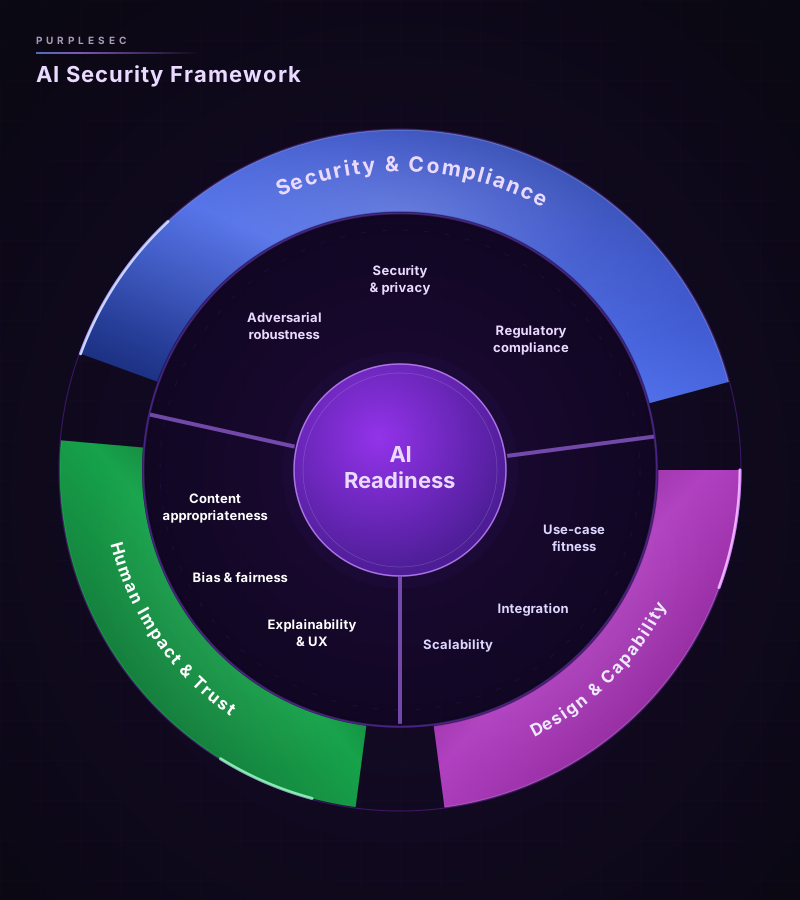
A Practical Framework For Secure, Responsible AI
AI security is not a one-time deployment. It is an ongoing discipline. PurpleSec emphasizes structured discovery, contextual risk analysis, practical control implementation, and continuous refinement.
Frequently Asked Questions
What Is AI Governance In Cybersecurity And How Is It Different From AI Security?
AI security stops attacks against AI systems. Prompt injection, model theft, data exfiltration. AI governance decides what those systems are allowed to do in the first place, who approves each use case, and who is accountable when an approved system causes harm.
The two reinforce each other. Security controls without governance protect systems the business never sanctioned. Governance without security writes rules that attackers ignore. Mature programs treat them as the same discipline viewed from two directions.
Why Does AI Governance Matter Now If We Already Have Cybersecurity Policies?
Traditional cybersecurity policies assume deterministic systems where the same input produces the same output. AI systems do not behave that way. A model can pass every pre-deployment test and still produce a harmful output the next day because the input distribution shifted, an adversarial prompt slipped through, or the vendor silently updated the underlying model.
Governance fills that gap by adding ongoing human accountability and decision rights on top of static controls, so someone owns the outcome when the model drifts.
How Does AI Governance Map To NIST AI RMF, ISO/IEC 42001, And The EU AI Act?
The NIST AI RMF defines four functions (Govern, Map, Measure, Manage) but leaves implementation to each organization. ISO/IEC 42001 specifies the management-system requirements: policies, roles, and continuous improvement.
The EU AI Act adds hard obligations for high-risk systems including transparency, human oversight, and SBOM-style technical documentation. A complete governance program satisfies all three at once.
Many organizations start with NIST AI RMF for structure, add ISO 42001 for auditability, and layer EU AI Act requirements for regulatory coverage.
Who Should Own AI Governance In Our Organization?
AI governance is cross-functional by design. Security assesses technical risk, legal owns regulatory exposure, IT controls infrastructure, and the business owns use cases and outcomes. A mature structure pairs an AI Steering Committee at the executive level setting direction, an AI Governance Committee approving individual use cases, and an AI RACI Matrix making accountability explicit for every decision.
A Chief AI Officer or AI Safety Officer serves as the single throat to choke when something goes wrong.
What Is The Difference Between An AI Steering Committee, An AI Governance Committee, And An AI Center Of Excellence?
- The Steering Committee is strategic. Executives set direction, funding priorities, and enterprise risk appetite.
- The Governance Committee is operational. It approves new use cases, rules on policy exceptions, and reviews incidents.
- The Center of Excellence is practitioner-focused. It standardizes tooling, trains teams, and curates reusable patterns so every business unit does not reinvent AI adoption.
What Is The First Step To Building An AI Governance Program?
Discover first. Draft policy second. Run an AI Risk Assessment to inventory every AI system in use, including the shadow tools employees adopted without approval, and map each to a risk tier. That scored inventory becomes the backlog your governance program works from. Organizations that draft policies before discovery end up with documents nobody uses and shadow AI nobody sees.
How Do We Enforce AI Governance When Employees Already Use Unauthorized AI Tools?
Enforcement before enablement fails. Start with an amnesty window where employees disclose what they use, how, and for what, paired with a fast approval path for the legitimate cases. Pair that with an AI Gateway at the network layer so unsanctioned tools are visible and block-able, and an AI Acceptable Use Policy that sets clear consequences for ongoing violations. The Gateway makes enforcement mechanical rather than interpersonal, which is what usually kills governance programs before they take hold.
Related Glossary Categories
The 21 attack vectors and failure modes spanning prompt injection, data exfiltration, bias, and supply chain compromise, each tied to measurable business impact.
Meeting regulatory obligations like the EU AI Act, NIST AI RMF, GDPR, and ISO 42001 before enforcement gaps become audit findings.
Identifying, assessing, and prioritizing AI-specific threats to apply controls proportional to actual business impact.
Validating an AI system’s resilience against prompt injection, jailbreaking, data poisoning, and model manipulation before attackers do.
Ensuring AI systems operate fairly and transparently by closing the gap between what a model can do and what it should.
Protecting personal data throughout the AI lifecycle, from training collection through inference outputs, to prevent unintended exposure.
Securing the third-party models, datasets, and libraries an AI system depends on to prevent hidden backdoors in production.
Catching attacks and silent model failures at the inference layer, where natural-language payloads and behavioral drift escape signature-based tools.
The structured process for containing, investigating, and recovering from AI security events when preventive controls fail.