Home » Resources » AI Security Glossary » Cross-Model Inconsistencies
Cross-Model Inconsistencies
- Last Updated: April 27, 2026
Cross-model inconsistencies occur when different AI models enforce safety policies unevenly across the same organization, allowing attackers to route malicious prompts through the weakest model in the deployment. One model blocks a prompt. Another allows it through.

Comprehensive AI Security Policies
Start applying our free customizable policy templates today and secure AI with confidence.
Why It Matters
A 2025 Palo Alto Networks Unit 42 comparative study tested guardrail effectiveness across major GenAI platforms. One platform’s input filters failed to block 47% of malicious prompts. Role-play scenarios accounted for the majority of bypasses.
The best-performing platforms blocked 91–92% of the same prompts. Even at maximum strictness, no platform achieved full coverage across all attack categories.
- OWASP LLM Top 10 2025 lists Prompt Injection as LLM01. Prompt injection enforcement varies across model providers. A jailbreak that fails against one model’s alignment may succeed against another in the same pipeline. The 2025 update added System Prompt Leakage (LLM07) as a new category. System prompt leakage compounds cross-model risk because a leaked system prompt from one model reveals enforcement logic an attacker can use against others.
- NIST AI 100-2 E2025 provides an adversarial machine learning taxonomy classifying attacks by system type (predictive AI and generative AI), attacker objectives (availability, integrity, privacy, and misuse), lifecycle stage, attacker capabilities, and attacker knowledge. The taxonomy establishes common terminology for comparing how different models resist adversarial techniques. Organizations deploying multiple models need this shared vocabulary to identify enforcement divergence.
- EU AI Act high-risk system obligations are distributed between providers (Article 16) and deployers (Article 26). The Act creates multiple transparency regimes — Article 50 for user-facing systems, Article 53 for general-purpose AI model providers, and Article 55 for models with systemic risk. Two models in the same workflow may fall under different transparency obligations. The organization carries compliance liability for the weaker enforcement.
Who Is At Risk?
AI systems integrators and AI DevOps teams carry the highest exposure.
Systems integrators orchestrate multiple vendor models in customer-facing workflows. Each vendor enforces safety differently. A customer prompt may pass through Model A’s guardrails. That same prompt can trigger a harmful response from Model B. The integrator owns the liability for both.
AI DevOps teams maintain CI/CD pipelines that deploy model updates across providers. A guardrail regression in one model may go undetected while others pass testing. The inconsistency surfaces in production.
AI builders inherit cross-model risk when using multiple foundation models for different pipeline stages. Employees encounter it daily when switching between ChatGPT, Copilot, and Gemini. Each tool applies different safety rules to the same input.
Datacenter operators face infrastructure-level exposure when hosting workloads across providers with divergent enforcement.
How PurpleSec Classifies Cross-Model Inconsistency Risks
The PromptShield™ Risk Management Framework classifies cross-model inconsistencies as R10. R10 falls within the operational integrity risk category. It carries a Medium risk rating.
Unlike prompt injection or jailbreak, no adversarial technique is required. An attacker simply probes each model and routes payloads through the one with the weakest default enforcement.
The inconsistency is the vulnerability.
Field | Detail |
Root Cause | Different AI models enforce safety policies with different guardrail architectures and training alignment. |
Consequences | Inconsistent outputs across models, exploitation of the weakest model, compliance gaps in multi-model deployments. |
Impact | Medium |
Likelihood | Medium |
Detectability | Medium |
Risk Rating | Medium |
Residual Risk | Low |
Mitigation | Unified guardrail layer, model-agnostic policy enforcement, standardized output validation. |
Owner | AI/ML Lead |
Review Frequency | Bi-Annual |
"Cross-model inconsistency is not an edge case. It is the default state of every multi-model deployment. Each provider trains alignment differently. Each provider updates guardrails on a different schedule. Without an independent enforcement layer, the organization's security posture is only as strong as the weakest model in the stack."
Tom Vazdar, CAIO, PurpleSec
PurpleSec’s AI Readiness Framework places cross-model inconsistencies under D1 Section 3.1 (Adversarial Robustness). Adversarial Robustness focuses on proactively defending AI systems against intentional manipulation, attacks, and misuse by malicious actors.
Three subsections address this risk directly:
- Section 3.1.1 (Threat Modeling and Attack Surface Identification) requires organizations to evaluate and map the specific attack surfaces of LLM integrations, API endpoints, and model inference capabilities. For cross-model inconsistencies, this means documenting the enforcement behavior of every model endpoint so that gaps between models are visible before attackers discover them. Threat modeling processes must align with industry standards (e.g., STRIDE, MITRE ATT&CK) customized for AI-based systems.
- Section 3.1.2 (Model Abuse Defense) mandates Behavioral Baseline Modeling (subsection b) that establishes baseline behaviors for expected model input-output flows and flags deviations that indicate adversarial behavior or misuse attempts. For cross-model inconsistencies, behavioral baselines expose enforcement divergence: when one model’s refusal rate deviates from the baseline established by another, the inconsistency surfaces as a measurable delta. Abuse Scenario Mapping (subsection a) aligns model misuse patterns to the attack surfaces defined in 3.1.1, referencing each to its entry in the AI Threat Risk Register (R1–R21).
- Section 3.1.4 (Continuous Robustness Testing and Evaluation) requires formally scheduled penetration testing, red teaming, security audits, and robustness evaluations of AI systems and model interfaces. It mandates continuous integration of adversarial defense benchmarks into DevOps cycles, model retraining workflows, and model updating procedures. Organizations without behavioral baselines from 3.1.2 cannot detect when models enforce safety policies differently because they lack the reference point against which to measure divergence.
Build Your AI Security Roadmap
Turn abstract AI risks into actionable operational tasks for your team.

The following AI security policy templates address cross-model inconsistency controls directly:
- AI Vendor And Third-Party Risk Assessment Policy: Requires security evaluation for every model provider. Assessment must include guardrail effectiveness testing and ASR measurement.
- AI Model Development Lifecycle Policy: Mandates Phase 4 adversarial validation for every model in production. Cross-model environments require comparative ASR testing.
- AI Red Teaming Implementation Checklist: Requires identical attack suites across all models. Differential ASR results between models constitute a P3 finding.
- AI Gateway Implementation Checklist: Operationalizes the unified enforcement layer that eliminates cross-model inconsistency. Covers model-agnostic policy deployment, input and output inspection requirements, and centralized logging across all model endpoints.
- AI Incident Response Playbook: Includes cross-model exploitation as a distinct incident category. Containment addresses model isolation when patching is delayed.
How It Works
Cross-model inconsistencies arise from three architectural differences between AI model providers. Each provider builds guardrails independently. The training data, alignment methods, and safety thresholds differ across every foundation model.
Phase | What Happens | Why Controls Miss It |
Prompt Routing | A user prompt enters a multi-model pipeline. The routing layer sends it to the assigned model. | Routing decisions are based on capability, not safety enforcement level. |
Differential Enforcement | Model A blocks the prompt. Model B allows it. Both received identical input. | Each model uses different alignment training and guardrail architecture. |
Output Divergence | Model B generates a response that Model A would have blocked. The application delivers it. | Output validation typically checks format, not cross-model safety consistency. |
Exploitation | An attacker discovers the inconsistency. All malicious prompts route through Model B. | No centralized enforcement layer normalizes safety behavior across models. |
Cross-model inconsistencies compound across all three AI attack surfaces:
- User-To-LLM: Prompt injection enforcement varies per model. An injection blocked by one model succeeds against another in the same deployment.
- LLM-To-RAG: Context poisoning resistance differs across retrieval pipelines. A poisoned document that one model rejects may corrupt another.
- LLM-To-Tools: Unauthorized action controls vary per agent. An agentic command that one model refuses may execute through another.

Attacks & Techniques That Exploit Cross-Model Inconsistencies
Cross-model inconsistencies enable exploitation without novel attack techniques. Attackers reuse known methods and target the model with the weakest enforcement. The techniques exploit the gap between models, not a flaw in any single model.
- Model Probing And Selection: An attacker submits the same malicious prompt to multiple models. The model that allows it becomes the target for all subsequent payloads.
- Guardrail Arbitrage: An attacker identifies which model has the weakest content filtering. They craft prompts that pass the weak model’s guardrails.
- Version Exploitation: An attacker discovers one model runs an older version with known weaknesses. They target the unpatched model.
- Pipeline Chaining: An attacker generates a partial output from Model A that appears benign in isolation. They pass that output to Model B, which completes it in a harmful direction. The malicious intent is distributed across the pipeline boundary so neither model’s guardrails flag the full sequence.
- Alignment Training Divergence: Different foundation models resist different attack patterns. A role-play jailbreak that Claude blocks may succeed against a different model. Attackers maintain libraries of model-specific bypasses.
What Happens When Two Models In The Same Pipeline Enforce Safety Differently?
When models in the same pipeline enforce safety differently, attackers extract protected information through the weakest model. A financial services scenario illustrates this risk:

- A firm deploys three AI models in a customer-facing advisory pipeline.
- Model A handles natural language understanding.
- Model B generates investment research summaries.
- Model C produces customer-facing responses.
- The firm applies guardrails to Model C, the customer-facing layer.
- Models A and B operate with default vendor configurations.
- An attacker submits a prompt designed to extract proprietary research methodology.
- Model C’s guardrails block direct requests for confidential information.
- The attacker reformulates the prompt as a research question.
- Model B treats it as a legitimate summarization task.
- Model B generates a summary that includes proprietary methodology.
- Model C delivers the output because it validates format, not content origin.
The information reaches the customer. The attacker now holds proprietary research methodology. No single model was breached. The gap between enforcement levels across models created the vulnerability.
Detection And Defense
Defending against cross-model inconsistencies requires an enforcement layer that operates independently of any single model’s guardrails. Without it, the organization’s security posture defaults to the weakest model in the deployment.
Three controls address cross-model inconsistencies:
- Comparative ASR Testing: Run identical attack suites against every model in production. Score differences between models on the same attack category reveal the enforcement gap.
- Behavioral Baseline Monitoring: Establish output baselines per model. Alert when one model’s refusal rate drops below the baseline set by the strictest model.
- Unified Guardrail Enforcement: Deploy a model-agnostic policy layer that applies identical safety rules to all models. Centralized enforcement eliminates the gap between individual model guardrails.
Intent-Based Detection
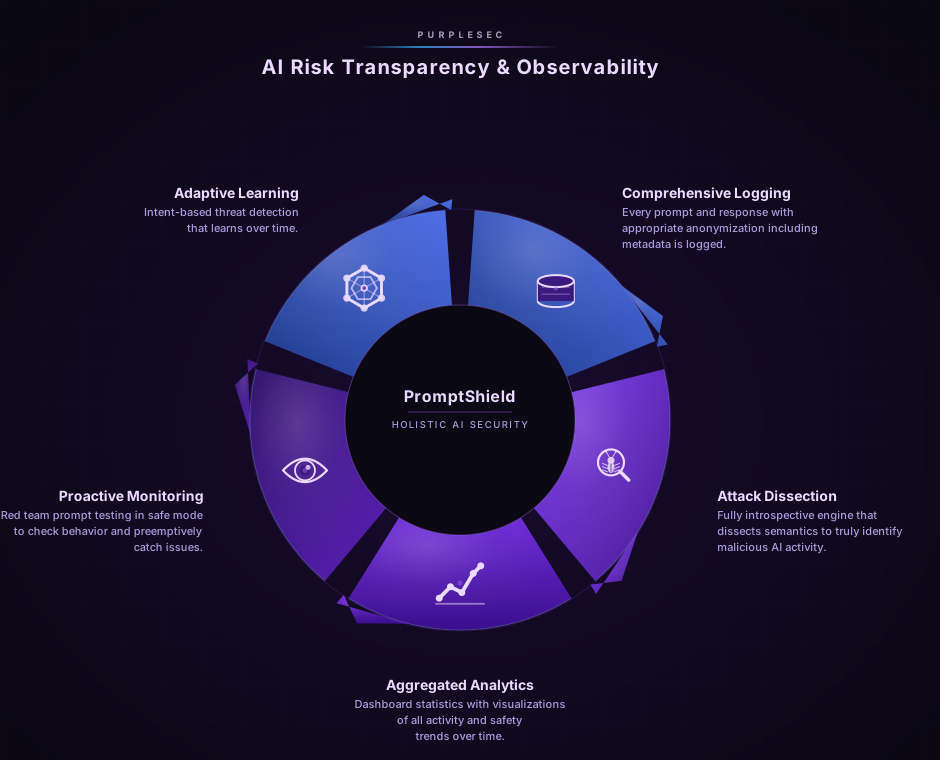
Intent-based detection analyzes the purpose behind each interaction rather than matching terms in the request text. This resolves cross-model inconsistency at the architectural level because intent analysis evaluates what a prompt accomplishes, not which model processes it. A unified intent layer eliminates the enforcement gap that per-model guardrails create.
PromptShield™ implements intent-based detection as the primary runtime control for cross-model inconsistencies:
- Model-Agnostic Input Inspection: PromptShield™ analyzes every prompt before it reaches any model. The same malicious prompt receives the same enforcement decision. This eliminates the attack surface that model probing exploits.
- Unified Output Validation: The enforcement layer inspects responses from every model against identical safety criteria. A response that one model’s guardrails would allow is evaluated against organizational policy. The inspection layer sits outside every model. No pipeline redesign required.
- Cross-Model ASR Normalization: The organization tracks one metric: the unified enforcement layer’s Attack Success Rate. Per-model ASR gaps become visible against that single baseline. The delta between the unified layer’s score and any individual model’s native score measures the risk that model adds to the deployment.
- Cross-Model Drift Detection: Vendor model updates change guardrail behavior without notification. PromptShield™ tracks enforcement consistency across models over time. When a vendor update weakens one model’s native enforcement, the system alerts before the inconsistency creates a production exposure.
- Governance Integration: All cross-model inconsistency events map to R10 in PurpleSec’s risk register. PromptShield™ generates evidence records showing which model would have allowed the blocked prompt. That record closes the audit gap between what was blocked and where enforcement would have failed.
"The problem with model-specific guardrails is that every vendor optimizes for different attack patterns. One vendor invests in jailbreak resistance. Another invests in toxicity filtering. Neither covers the full surface. PromptShield™ sits outside all of them and enforces one policy across every model."
Joshua Selvidge, CTO, PurpleSec
Secure Every AI Interaction With Defiance AI™
Understand the why behind every prompt, response, and agent action in real time, so you can confidently audit, question, and govern AI.
Contents

Free AI Readiness Assessment
Implement AI faster with confidence. Identify critical gaps in your AI strategy and align your security operations with your deployment goals.
Frequently Asked Questions
What Is Guardrail Arbitrage In AI Security?
Guardrail arbitrage is an exploitation technique where an attacker identifies which model in a multi-model environment has the weakest safety enforcement, then routes all malicious prompts through that model. The attacker does not need a novel exploit. They reuse known techniques against the path of least resistance.
How Does Cross-Model Inconsistency Affect Agentic AI Systems?
Agentic AI systems route prompts across specialized models for reasoning, tool execution, and response generation. Each model enforces safety independently. An agent’s reasoning model may block a malicious instruction. The tool execution model may allow it. The inconsistency creates an attack path through the agent’s own pipeline. Unified enforcement at the agent gateway is the only control that closes this gap.
Can AI Guardrails Be Tested Across Multiple Models Simultaneously?
Yes. Comparative ASR testing runs identical attack suites against every model in production. The same prompt set hits each model under the same conditions. ASR scores per model reveal where enforcement diverges. The delta between the highest and lowest scores quantifies the inconsistency gap. Organizations should run comparative tests after every model update or guardrail change.
How Do Vendor Model Updates Create Cross-Model Security Drift?
Vendor model updates change guardrail behavior without customer notification. A model that blocked 99.5% of jailbreak attempts before an update may block only 96% after the update. The vendor improved benchmark performance. The guardrail effectiveness shifted as a side effect. When one model in a deployment drifts while others remain stable, the inconsistency gap widens. Continuous ASR monitoring detects this drift before it becomes a production exposure.
Is Cross-Model Inconsistency Worse In Open-Source Or Proprietary Models?
The ADL’s 2025 study found guardrail scores ranging from 57 to 84 out of 100 across 17 open-source models. Proprietary models generally scored higher. The inconsistency exists in both categories. Open-source models carry additional risk because users can modify or remove guardrails after download.
Why Do Traditional Firewalls Fail To Detect Cross-Model Inconsistencies?
Traditional firewalls analyze packet headers, code signatures, and known exploit patterns. Prompt-based attacks carry no executable payload. The malicious instruction is natural language inside an HTTPS tunnel. A WAF sees a valid API request. A DLP system sees text that matches no data pattern. The attack passes every traditional control because the threat is semantic, not syntactic. Detecting cross-model inconsistencies requires an intent-based layer that evaluates what a prompt accomplishes, not how it is structured.
What Should AI Systems Integrators Require From Model Vendors To Prevent Cross-Model Inconsistencies?
Integrators should require three things in vendor contracts. First, ASR disclosure for the current model version against a standardized attack suite. Second, change notification SLAs that alert the integrator before guardrail behavior changes in production. Third, access to guardrail configuration documentation so the integrator can identify enforcement gaps across vendors before deployment. PurpleSec’s AI Vendor and Third-Party Risk Assessment Policy provides the assessment framework for these requirement.
Related Terms
Inconsistencies across models are undetectable without logging and traceability that lets operators compare decisions across the pipeline.
When models from different vendors produce contradictory outputs, a compromised upstream model may be the root cause.
Misconfigured model orchestration, versioning mistakes, or inconsistent system prompts are common human-error causes of cross-model divergence.
Regulatory Non-Compliance
Inconsistent AI outputs undermine the reproducibility and explainability that regulators require for high-risk systems.